Group Tour Agencies in Morocco: How to Pick the Right One
Compare Morocco group tour agencies by trip style, reviews, pace, transport and inclusions. Learn wh...
Read this article
Private, custom Morocco trips planned in Fez by AZ-ZDDINE, working in Moroccan tourism since 2012. Sahara, Atlas, medinas and coast, arranged around you.
Written by AZ-ZDDINE, who runs Morocco Classic Tours from the Fez medina and has worked in Moroccan tourism since 2012. Everything below comes from our own trips and the Berber families we work with in Merzouga.
Most of what gets written about camel riding in Morocco is written by people who took one ride, or by people who never left their desk. This page is different. I run these treks. I know how long the ride really takes, what hurts after an hour, who should not get on a camel at all, and how the animals are looked after, because I have worked with the same families for years.
If you only read one section, read the one on ethics. It is the question I am asked most by American travellers, and it deserves a straight answer.
It can be, and it often is. But it depends entirely on who you book with, and the difference is visible if you know what to look at.
I do not own the camels. I work with several local Berber families in the Merzouga area who own and care for them, and I have worked with the same families for many years. I know them personally. Camel trekking is how they support their households, and they look after their animals every day because those animals are their living.
That matters for a practical reason as well as a moral one. A family whose income depends on a camel for the next fifteen years treats it very differently from an operator renting animals by the day.
In the busy season, one camel usually does two rides a day: one in the morning for sunrise, one in the evening for sunset. That is roughly two hours of work in total. The rest of the day the camels eat, rest and recover, and their owners make sure they get that time.
Water works differently from what most visitors expect. In winter a dromedary drinks very little, often only once a week or once every ten days. In summer they need more, around twice a week. For food they graze through the day.
Look at the animal's body. A camel that is extremely thin, with its ribs clearly visible, a weak appearance, or a hump that has lost much of its shape, is probably not being fed or rested properly. You do not need to be an expert. A healthy working camel looks solid and its hump holds its form.
Two other things worth noticing: whether the camels have shade and water at the staging point, and whether the handler is calm with them. A man who has worked with the same animals for years does not need to shout or pull.
The other half of this is where your money goes. I make sure payment reaches the camel owners themselves, the people who feed the animals and care for them, rather than disappearing into a chain of middlemen. If a price looks impossibly cheap, someone in that chain is being squeezed, and it is usually the family at the end of it.
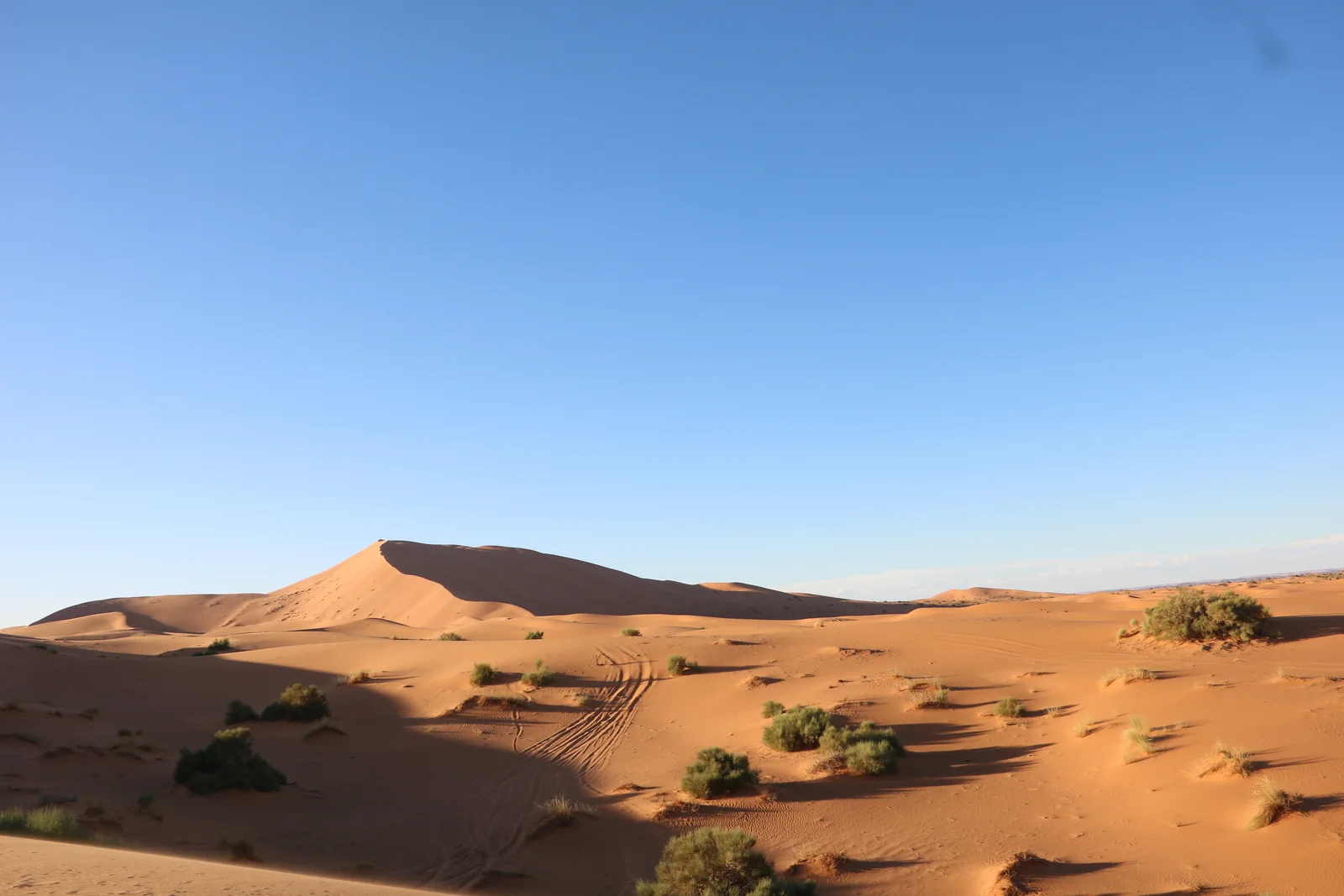
This is where I send people, and it is what I recommend to a first-time visitor without hesitation. Erg Chebbi is real Sahara: tall golden dunes, quiet, and genuinely beautiful at either end of the day. It is also reachable, which matters more than people expect when they are planning a two-week trip.
If an American couple asks me which desert to choose, I say Merzouga. The dunes, the silence and the landscape are what they came for, and this is where they find it.
I will say this plainly, because a lot of people book the wrong one and are disappointed. Zagora is a rocky desert. If you want the real Sahara sand dunes, that is Merzouga.
Zagora is closer to Marrakech, which is why it is sold so heavily as a two-day trip. It is not a bad place. But if your picture of the Sahara is the one with the dunes in it, Zagora is not that picture, and no amount of driving time saved will fix that once you arrive.
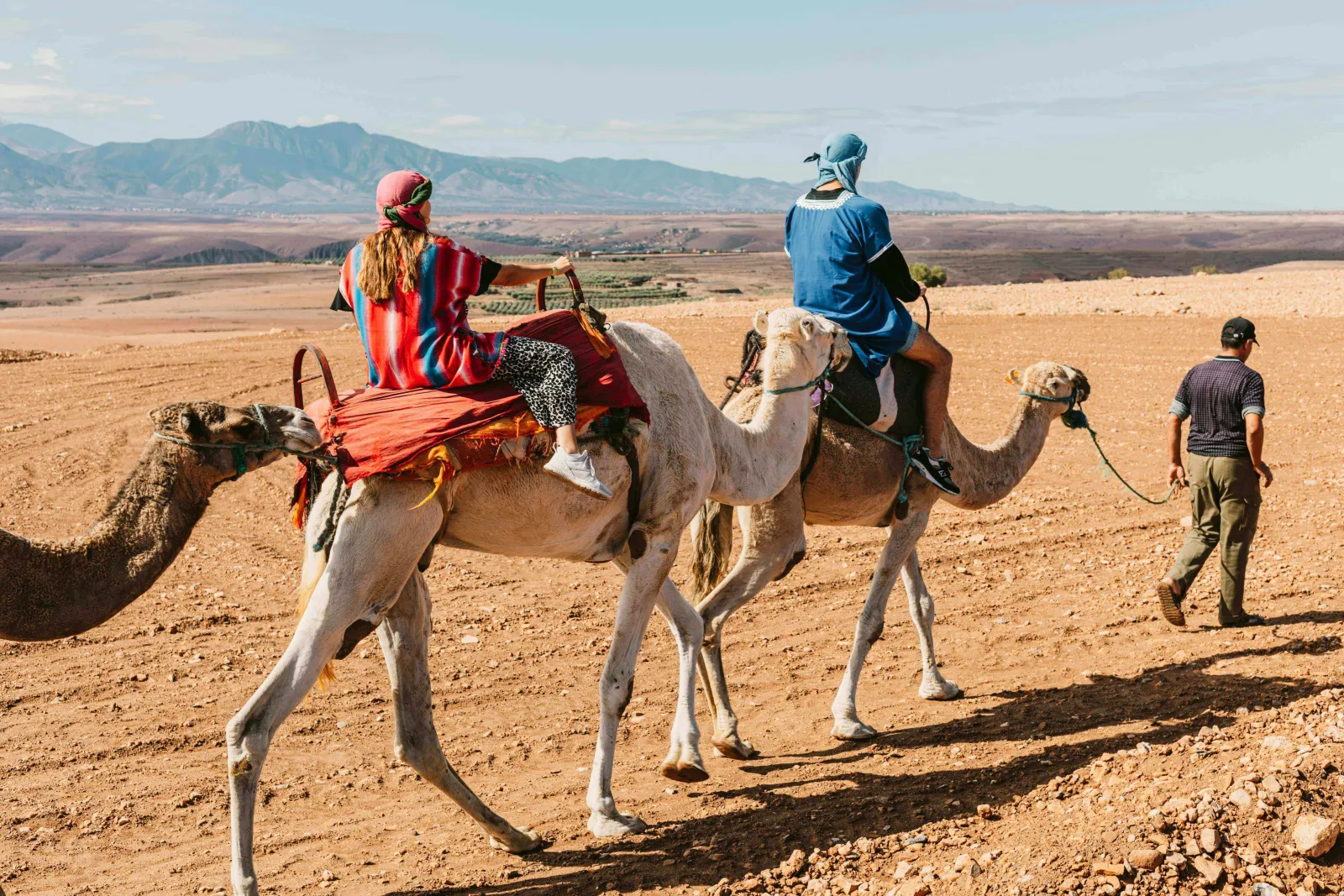
There are short camel rides available much closer to Marrakech, in the Agafay area. They are an hour out of the city rather than a full day, and they suit someone who simply wants the experience of sitting on a camel and has no time for the Sahara.
Be clear with yourself about what that is, though. Agafay is a stony desert landscape, not dunes. If you are weighing it up, we have written separately about what a camel ride in the Agafay desert costs.
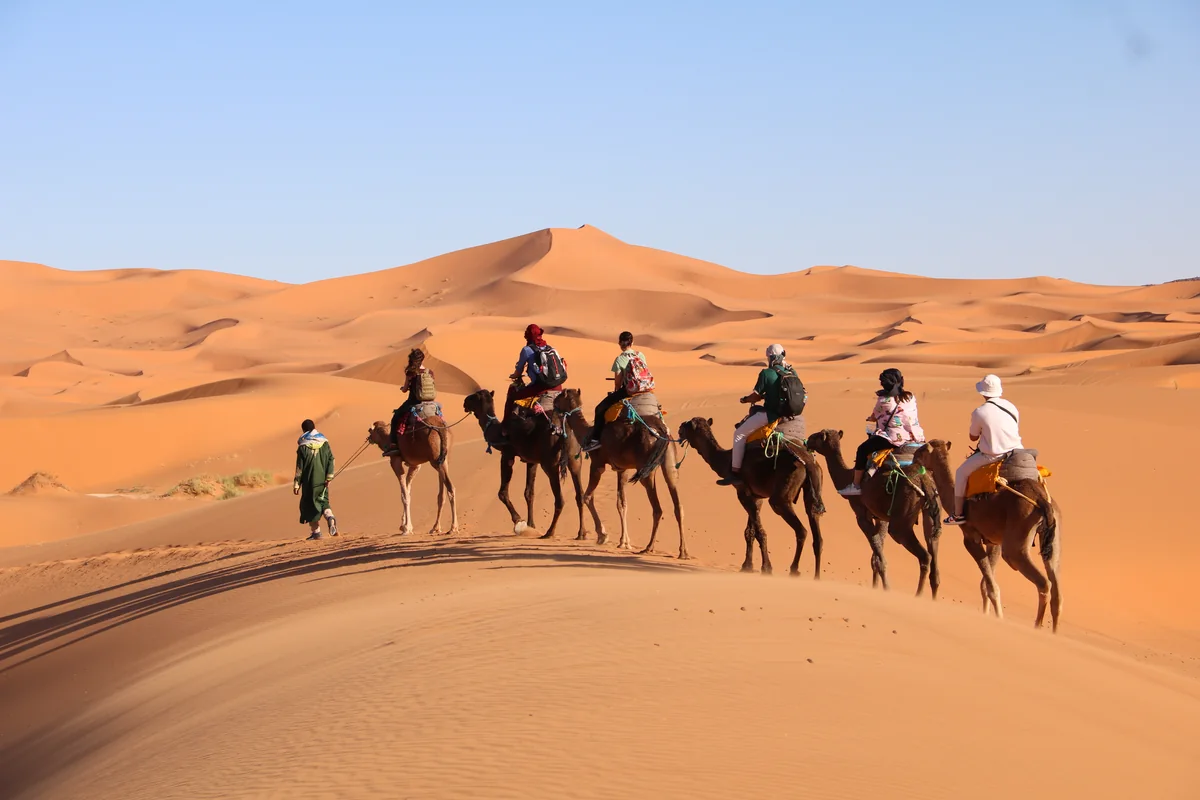
On our trips the camel ride is about an hour across the dunes, timed for sunset. It goes out from the desert camp and brings you back. Across the camps near Merzouga the range is roughly 40 to 90 minutes, depending on how far into the dunes the camp sits.
That is the part most pages get wrong or leave vague. It is not a ten-minute photo opportunity, and it is not a half-day expedition either. Plan for about an hour on the animal, in the last of the light.
You do not ride in to the camp. You reach the camp first, by Jeep from Khamlia, which takes about 20 minutes. Your luggage goes with it. The camel ride comes afterwards, once you have had tea and put your bag in your tent.
You are not committed to the whole thing. Plenty of guests ride out for ten or fifteen minutes, take their photographs on the dune, and walk or come back by Jeep. Nobody minds, and nobody is left behind at the camp.
The ride is optional in the first place. If you would rather not get on a camel at all, a Jeep takes you out to the dunes for the sunset instead. You still get the desert, the light and the night sky — which, for most people, is the part they actually came for.
This is the part that frightens people, and it is worth knowing before it happens. The camel is sitting when you get on. To stand, it rocks sharply forward onto its front knees, then pushes up at the back. For a second you are tipped forward at a steep angle.
Hold the handle on the front of the saddle firmly, with both hands, and lean back slightly as it rises. Same again, in reverse, when it sits down at the other end. That one instruction prevents almost every nervous moment we see.
Honestly: most people start to feel it in the backside and the legs, especially first-time riders. The gait is a slow side-to-side roll and your body is not used to it. It is not painful, but after about an hour you will be ready to get off.
This is one reason I suggest a shorter ride, or coming back by Jeep, for anyone who is unsure. There is no prize for enduring the full distance.
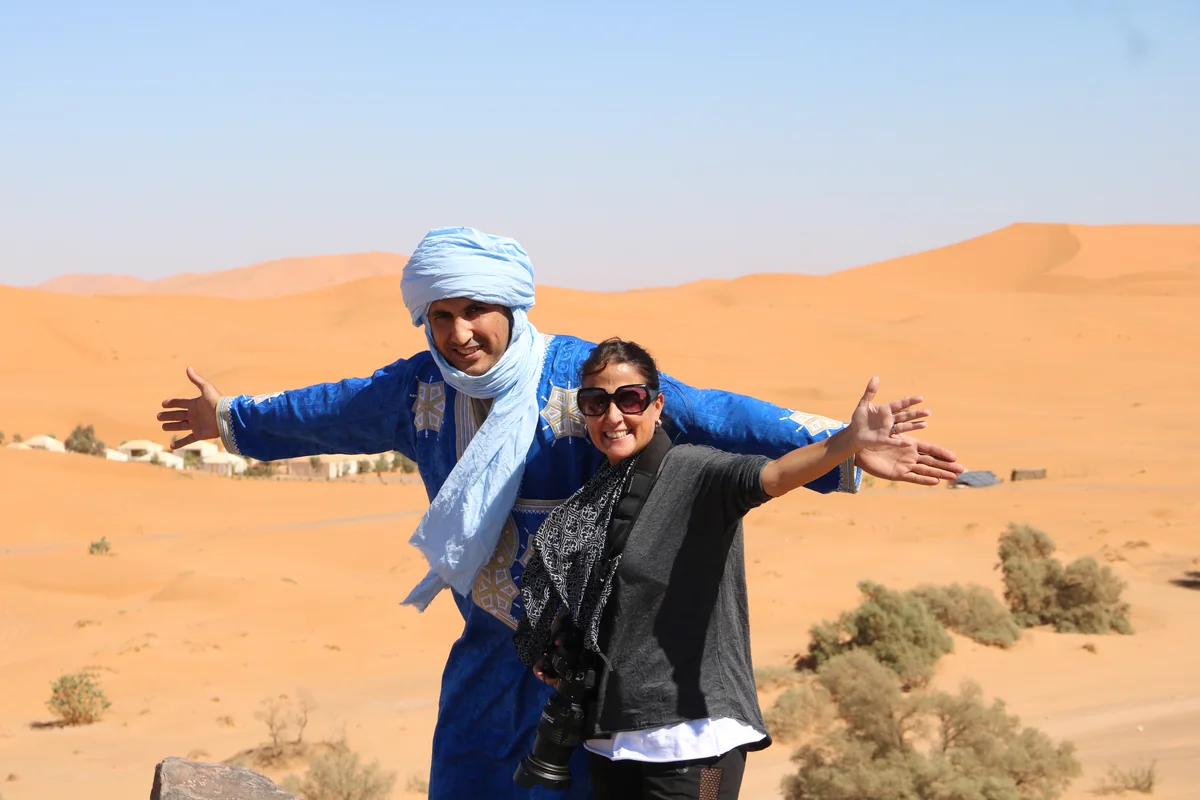
I would rather tell someone honestly beforehand than watch them have a bad afternoon.
A camel can usually carry up to around 150 kg (about 330 lb), depending on the individual animal and local safety practice. If a guest is above that, or simply prefers not to ride, they simply skip the ride and go out to the dunes by Jeep for the sunset instead. It is a normal request and it is arranged quietly.
The oldest guest I have put on a camel was 80. She rode for a few minutes, took her photographs, and then continued by jeep. That is a good model for anyone who wants the experience without the hour.
Children love it, and for them it is often the highlight of the whole trip. Children under six should ride with a parent for safety.
If you have a bad back, bad knees or a hip replacement, my honest advice is not to spend the night at the camp. It is not the camel that is the problem, it is the drive. The 4x4 route in over the dunes is rough and jolting, and it will find any weakness. Stay at a hotel in Merzouga instead, do a short ride at sunset, and sleep in a proper bed.
I have told clients not to ride before, for health reasons or age. Nobody has ever been annoyed with me afterwards.
The camel ride is not the destination, and it is not how you get there either. The camp is, and it is most of what people remember.
We meet the camp team at Khamlia, the village on the edge of the dunes. You and your luggage go into a Jeep and they take you into the desert, about twenty minutes. You arrive to mint tea and Moroccan cookies, or a cold drink if the day has been hot.
The camel ride goes out from there, later, when the light is right. You take nothing with you but a camera and a scarf — your bag is already in your tent.
We work with two camps near Merzouga: Sahara Stars Camp and Azawad Luxury Camp. They are partners, not ours, and I would rather tell you that than imply otherwise. A lot of operators describe a partner's camp as "our camp" and I do not see the point.
The tents have proper beds, private bathrooms, hot showers and running water, heating and air conditioning, electricity and Moroccan furnishings. It is more comfortable than most people expect from the word "camp", and considerably more comfortable than the bivouac tents that photograph well and sleep badly.
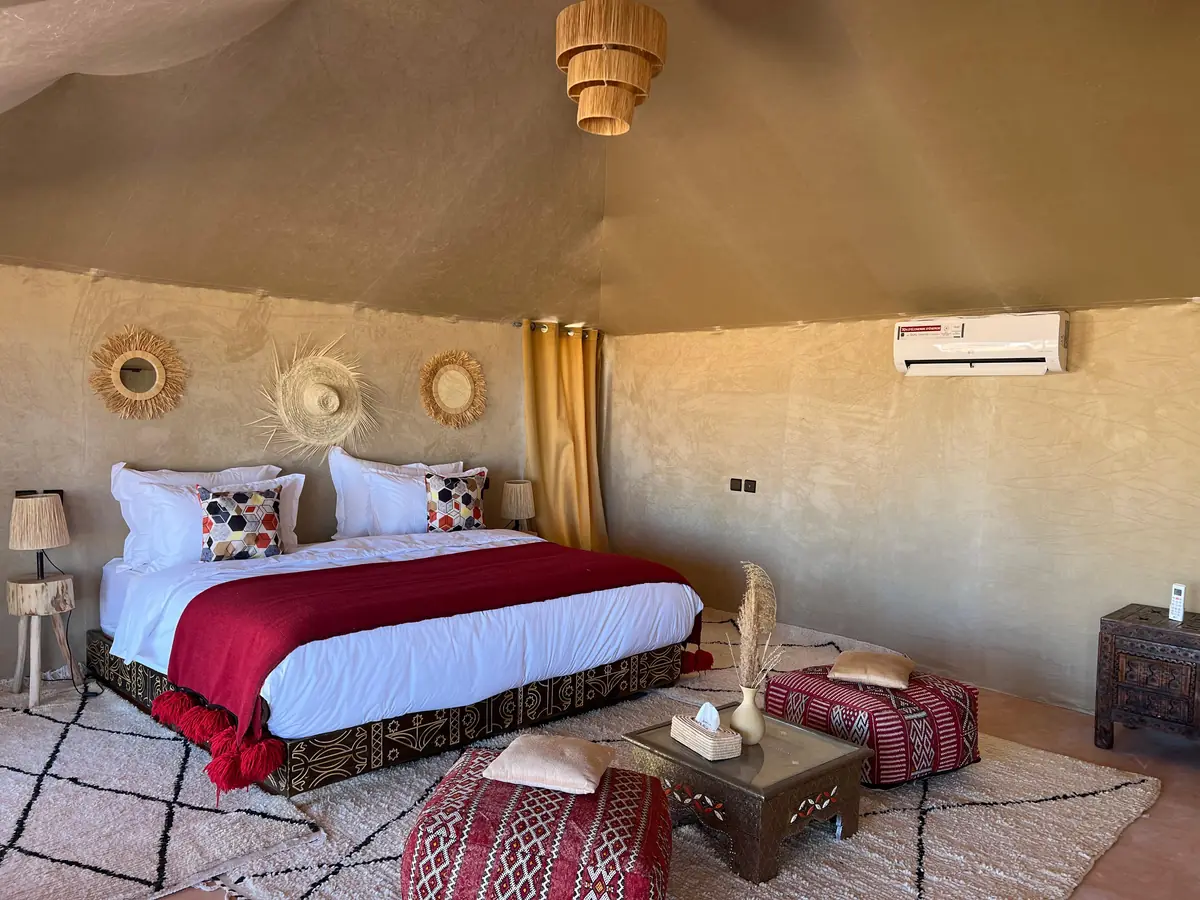
Dinner is served at the camp. Afterwards there are usually drums and music around the fire, played by the camp team rather than performed at you.
If the sky is clear, go and stand away from the fire for a few minutes and let your eyes adjust. There is very little artificial light for a long way in any direction, and that is the part guests talk about afterwards more than the camels.
This catches more people out than the heat does. The Sahara loses its warmth fast once the sun is down, and in winter the night temperature around Merzouga drops to a few degrees above freezing.
Bring a warm layer even in spring and autumn. The tents have heating, so the issue is not sleeping — it is the two or three hours you spend outside after dinner, which is exactly when you most want to be out there. A fleece and a scarf are enough.
We publish the month-by-month night temperatures on the Sahara desert tours from Fes page if you want to plan around them.
Khamlia is the village where we meet the camp team, and it is worth more than a transfer point. It is known across Morocco for its Gnawa music — a tradition carried north by people brought from sub-Saharan Africa centuries ago, with its own instruments, rhythms and repertoire.
On the morning after the camel ride, before we drive on, there is usually time to stop and hear it properly. It is not a show put on for tour buses; it is a small village where the music has simply continued. If your interest is in why the Sahara sounds the way it does rather than only how it looks, say so when we plan the trip and we will build the morning around it.
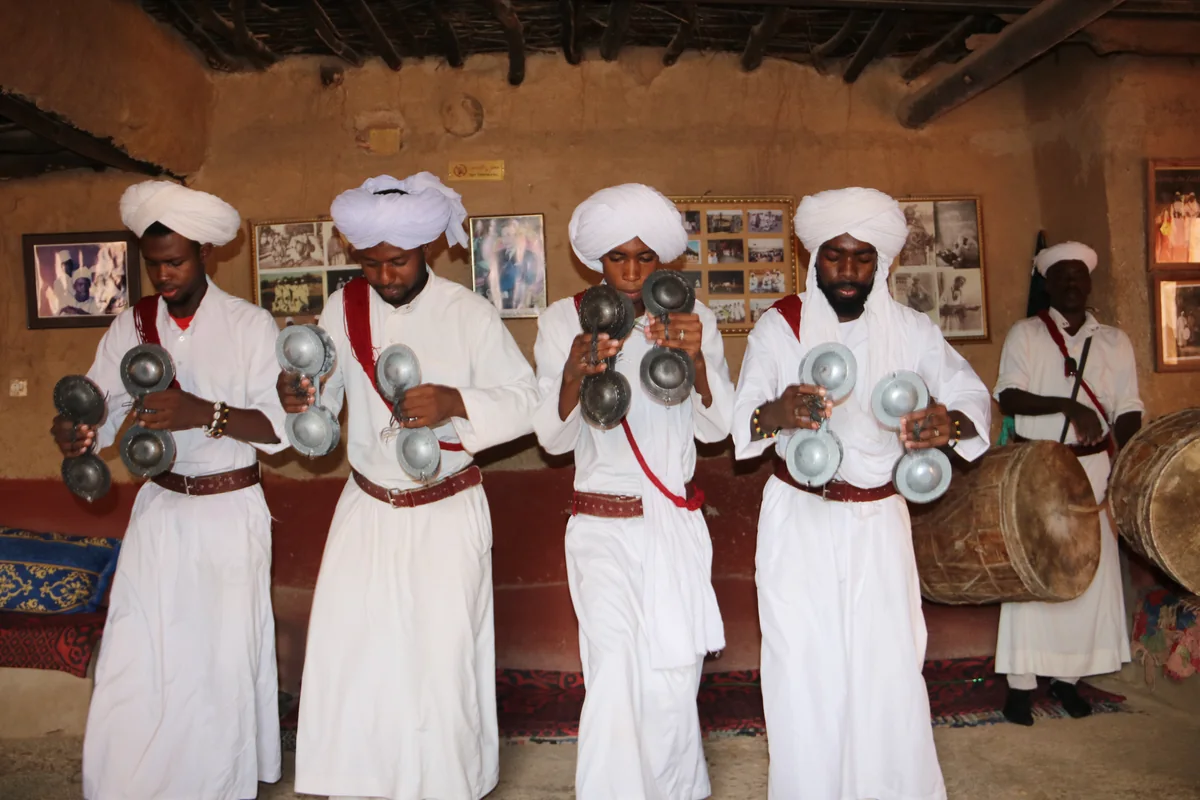
Both are good, and they are genuinely different. The light, the colour and the feeling of the desert are not the same at each end of the day.
If you are only doing one, I recommend sunset. It is your first contact with the Sahara, you arrive at camp as the light goes, and the whole evening follows from it. Sunrise is quieter and colder, and worth getting up for if you are staying the night anyway.
Do not come to the Sahara for a camel trek in July or August. Daytime temperatures climb above 45°C (113°F) and it is simply uncomfortable. People do it, and they do not enjoy it.
Spring and autumn are the best windows. Winter days are pleasant for riding, though the nights get genuinely cold in the desert, which surprises people. We publish the month-by-month night temperatures on our Sahara trips from Fes page.
A camel ride on its own, if that is all you want, is around $40 to $60 per person.
On our multi-day desert trips the camel trek and the night at the camp are already included in the trip price, so there is nothing extra to pay for the ride itself. Those prices are published in full on the Sahara desert tours from Fes page.
Be careful with prices that look too low. A very cheap short ride arranged on the spot usually means either the camel owner is being paid almost nothing, or there are costs appearing later. Neither is a good start to the evening.
Yes, you tip the camel handler, and it is expected rather than optional. Around $10 to $20 per person is normal, given directly to the man who led your camel.
Bring it in dirhams if you can. Foreign coins cannot be exchanged in Morocco and are no use to him.
People ask this more than you would think, so here is the real answer. A camel starts at around 30,000 Moroccan dirhams, roughly $3,000, and goes up considerably from there for a strong, well-trained trekking animal.
Most camels in Morocco come from the southern regions, where the hot, dry climate suits how they naturally live. That is also why the animals you ride in Merzouga are usually southern-bred.
Yes, though it is not everyday food for most Moroccans. It is expensive, and it belongs mainly to the south and the desert regions, where it has a real place in the food culture.
You will find it in local markets in Fes, Casablanca and Meknes. In the Fez medina, Café Clock serves a camel burger, and it is the easiest way to try it once if you are curious. Most visitors never come across it otherwise.
The things people most often wish they had brought:
A cotton scarf. It keeps sand and sun off your neck and face, and you can buy one locally if you forget.
A hat.
Sunscreen.
Sunglasses.
Lightweight, breathable long trousers. Long is better than short on a camel, for the sun and for the saddle.
Closed shoes rather than sandals, and a warm layer for the evening if you are staying at the camp. The temperature drop after dark is the thing visitors underestimate most.
Long trousers are not about modesty here, they are about comfort. A camel saddle is a wooden frame under a blanket, and bare legs against it for an hour is the single most avoidable mistake people make. Loose, light and long is the combination. Leggings are too thin, jeans are too stiff and too hot.
Do not bring a bag on the camel. Your luggage goes ahead by Jeep from Khamlia and will be at your tent when you arrive, so you only need what fits in a pocket. A phone or camera is fine, but keep it on a strap — a camel standing up is a sudden movement and things do fall.
Leave jewellery, heeled shoes and anything white at the hotel. Sand gets into everything and the light at sunset is orange, which does no favours to white clothing in photographs.
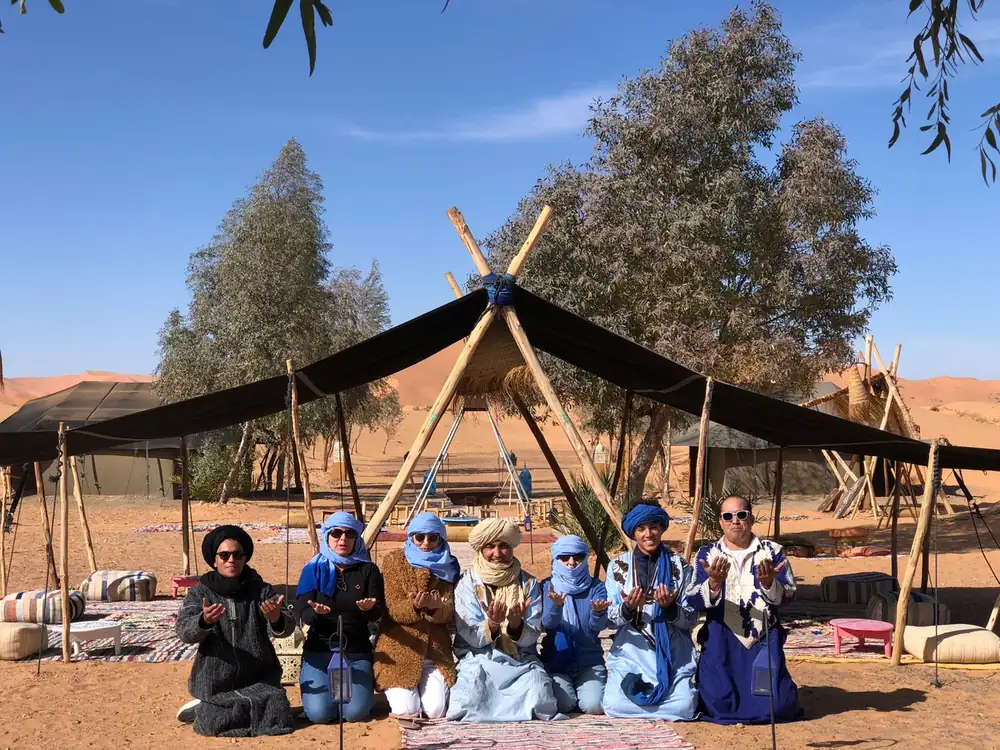
The weather, almost always. It can change suddenly here. The sky can look completely clear and a sandstorm will still arrive and spoil the ride. That is the most common disappointment, and there is nothing anyone can do about it.
We do cancel camel rides sometimes, for sandstorms or heavy rain, for the safety of both guests and animals. If that happens on your night it is the ride that is cancelled, not the camp — you are already there. We would rather move you than put you on a camel in a sandstorm.
It depends on the operator. Camels working two short rides a day with proper rest, food and water are well treated. Check the animal's condition before you ride: visible ribs, a weak appearance or a hump that has lost its shape are the signs of a camel that is not being cared for properly.
A camel ride costs around $40 to $60 per person on its own. Buying a camel is a different question: prices start at about 30,000 Moroccan dirhams, roughly $3,000, and rise from there for a strong trekking animal.
Yes, but it is not everyday food. It is expensive and most associated with the south and the desert regions. You can find it in markets in Fes, Casablanca and Meknes, and Café Clock in the Fez medina serves a camel burger.
Mainly Merzouga and the Erg Chebbi dunes, which is the real Sahara and what most people picture. Zagora and Erg Chigaga are the other desert options, though Zagora is rocky rather than sandy. Short rides are also available in the Agafay area near Marrakech.
About an hour across the dunes, timed for sunset, going out from the desert camp and back. Across the camps near Merzouga the range is roughly 40 to 90 minutes. You reach the camp itself by Jeep from Khamlia, which takes about 20 minutes.
A camel can generally carry up to around 150 kg (about 330 lb). Above that, or if you simply prefer not to ride, you go out to the dunes by Jeep for the sunset instead. You reach the camp by Jeep either way.
Spring and autumn. Avoid July and August, when daytime temperatures pass 45°C (113°F). Winter days are comfortable for riding but desert nights are cold.
The camel trek and the night at the desert camp are part of our Sahara trips from Fes, along with the drive through the Middle Atlas, the Ziz Valley and Erg Chebbi itself. Prices, the full route and what is included are on the Sahara desert tours from Fes page.
If you are still deciding whether the camel part is for you at all, we wrote an honest assessment of that too: is a Sahara camel ride worth it?
Tell us your dates and how many of you are travelling, and we will tell you honestly whether the ride suits your group.
Compare Morocco group tour agencies by trip style, reviews, pace, transport and inclusions. Learn wh...
Read this article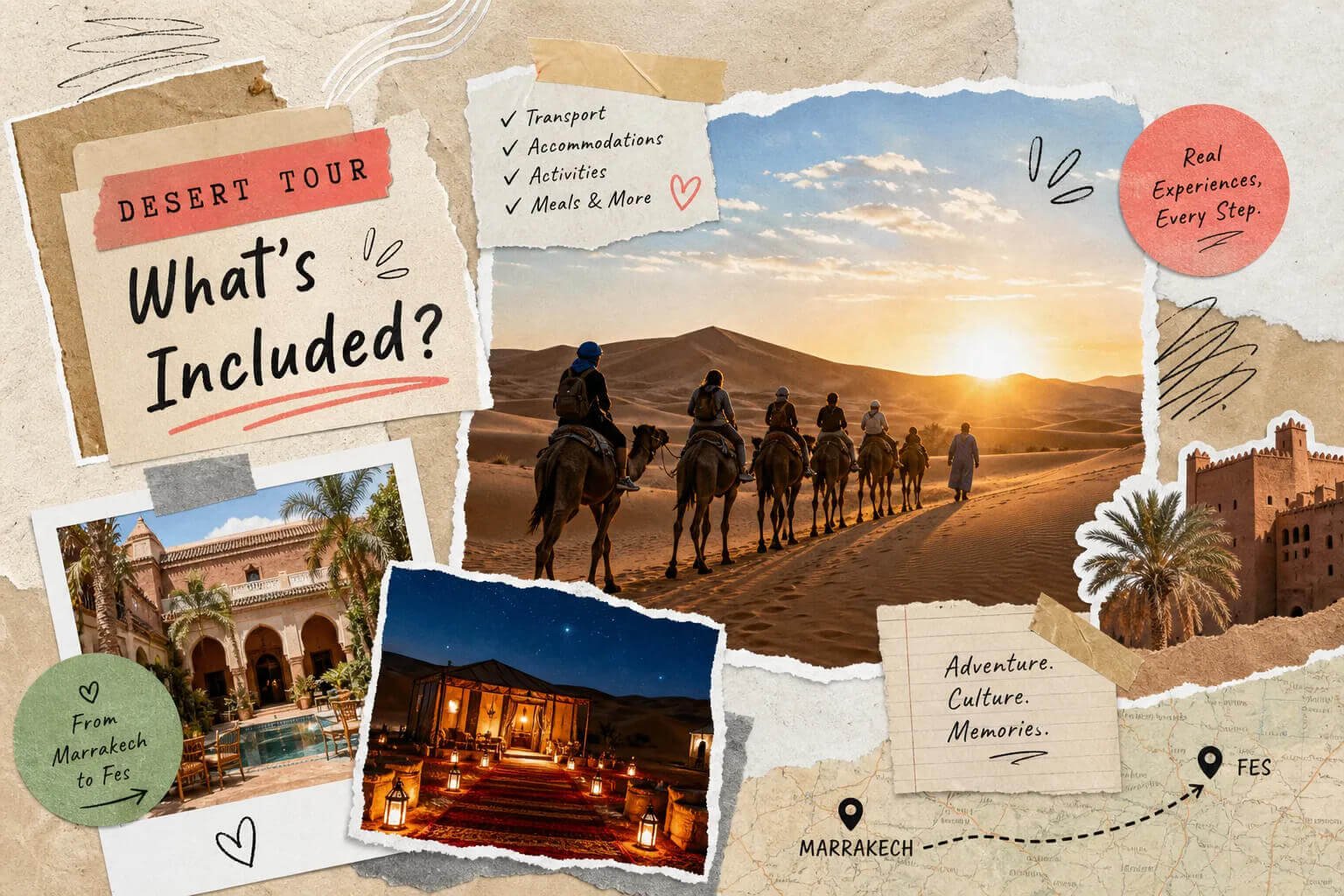
Uncover what a Marrakech to Fes desert tour offers, including camel rides, desert camps, and rich cu...
Read this article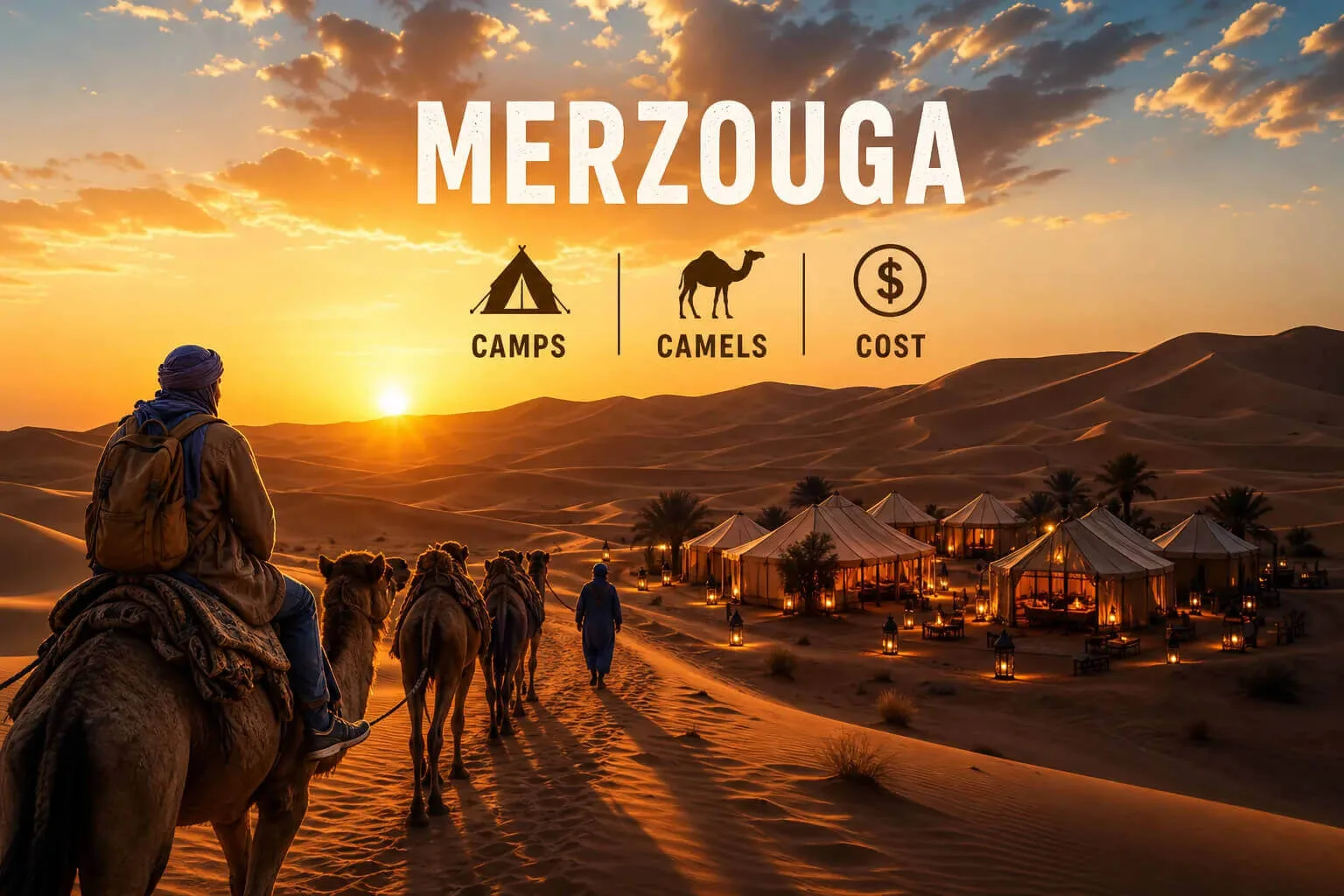
Join our Merzouga Overnight Tour for an authentic desert experience. Enjoy camel rides, comfortable ...
Read this articleWant cool tour deals and tips about Morocco? Enter your email and we’ll send them to you each month!
