Group Tour Agencies in Morocco: How to Pick the Right One
Compare Morocco group tour agencies by trip style, reviews, pace, transport and inclusions. Learn wh...
Read this article

We’ve helped people travel around Morocco for more than 15 years. We offer fun and easy packages to see famous places like the mountains, desert, and more.
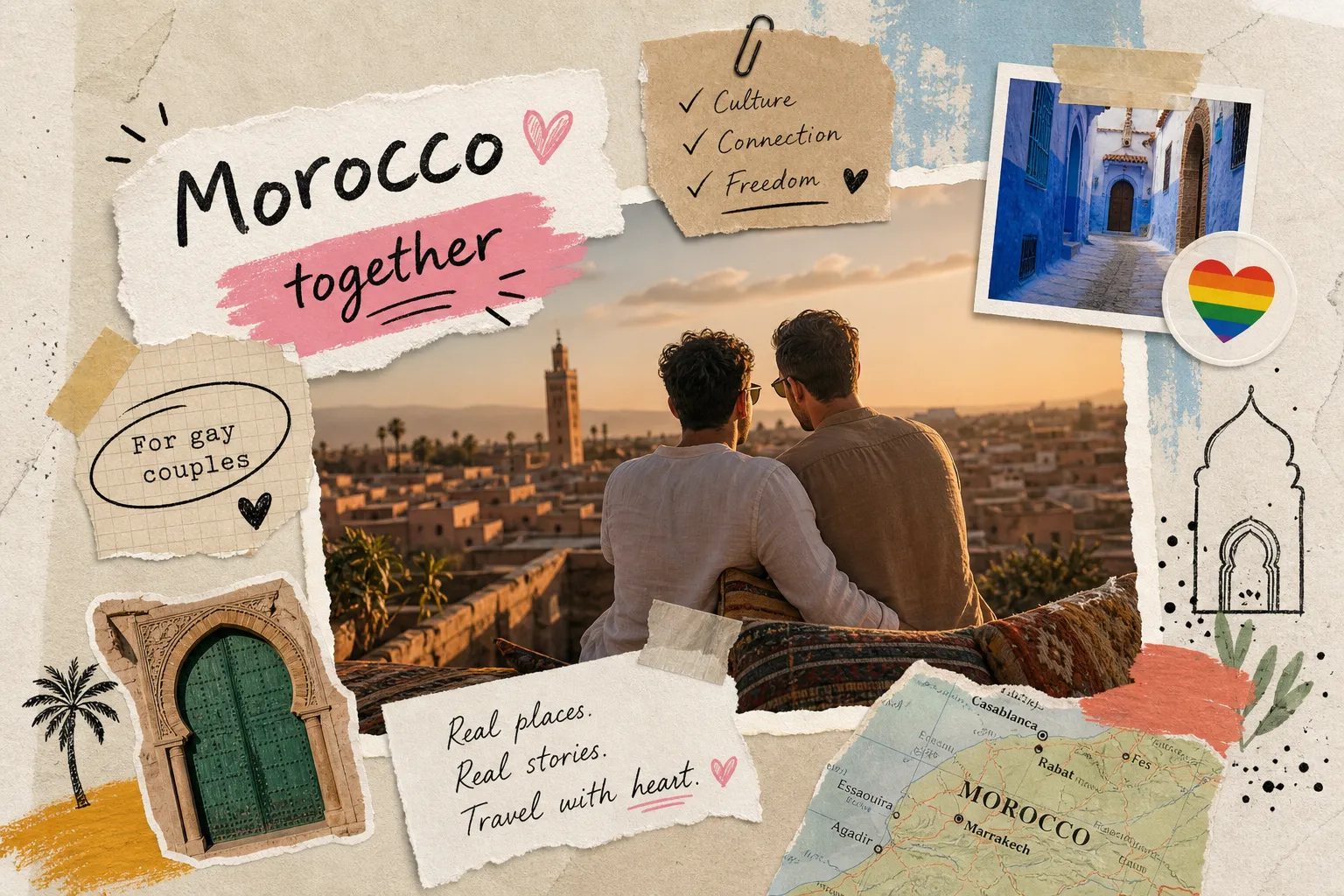
Morocco travel for gay couples sits at a rare and striking intersection: one of the most visually intoxicating, romantically charged countries on earth, and one where same-sex intimacy is illegal. The rose-tinted light over the Sahara at dawn, the carved cedar ceilings of a Fez medina riad, the smell of cumin and orange blossom drifting through a Marrakech souk- all of it is real, and so is the legal risk. Both of those things are true at once, and this guide isn't going to paper over either.
Think of this as the honest pre-trip conversation a well-traveled, well-informed friend would have with you before you booked flights. Not a scare tactic. Not a cheerful glossing-over. Just the real picture: what the law says, what enforcement actually looks like, which neighborhoods feel different, where to stay, how to move through the country, and what's genuinely waiting for you when you go in prepared. A growing number of same-sex couples are making this trip work beautifully, many of them with the help of a local operator like Morocco Classic Tours, which designs private, customized itineraries with comfort and discretion at every stop.
Morocco's Penal Code Article 489 criminalizes same-sex sexual activity for both men and women. The penalty is six months to three years in prison plus a fine. The law applies to private conduct, not just public behavior. That's the unvarnished truth, and you deserve to have it clearly before you make any decisions.
Enforcement is real and recent. In April 2024, police raided a villa near Casablanca during an LGBT gathering and arrested 80 people, according to reporting by human rights organizations including the Human Dignity Trust. In March 2024, the Royal Gendarmerie raided a house following a tip-off about "gay activities." These are not historical footnotes; they are recent events. That said, the documented enforcement pattern, as tracked by human rights bodies monitoring Morocco's same-sex laws, shows a meaningful difference between Moroccan nationals, people attending organized LGBT gatherings, and foreign tourists traveling as discreet couples. Clearly documented arrests of foreign visitors in the latter category are rare. That distinction matters, but it doesn't eliminate risk; it contextualizes it.
What "discreet" actually means here is worth spelling out plainly: you present as two friends traveling together in public, and you keep romance entirely private. No hand-holding near mosques, in medinas, or in rural areas. No PDA anywhere that draws attention or scrutiny. In your private riad or hotel room, you're a couple. In the street, you're not. That framework isn't ideal, but it's what has allowed couples to travel Morocco comfortably for years.
No Moroccan city is openly LGBTQ-affirming. But some are considerably more cosmopolitan, more internationally oriented, and less socially conservative than others, and that difference changes the day-to-day experience in concrete ways.
Marrakech is the most consistently recommended destination for gay travelers, particularly the Gueliz and Hivernage neighborhoods. Gueliz has wider boulevards, international cafés, upscale restaurants, and a social atmosphere that draws expats and tourists rather than primarily local crowds. The contrast with the Medina is real: the Medina is denser, more traditional, and more socially conservative. You can visit the Medina and should; it's extraordinary. But Gueliz is where you'll feel less watched as a couple moving through daily life. La Palmeraie and the upscale villa areas add another layer of privacy for those who want it.
Tangier has a reputation for being somewhat more liberal and has some mixed social spaces worth knowing about. Fez, Essaouira, and Casablanca are all viable as part of a broader itinerary, and Fez in particular has genuinely unmissable sights, but they require the same level of discretion as anywhere else in the country. The key variable isn't city; it's how cosmopolitan and internationally accustomed a given neighborhood feels, and how much of your time you're spending in private versus public spaces.
In conservative areas, near religious sites, in medinas, souks, and rural towns, PDA of any kind is the clearest risk trigger. The practical standard is simple: in public, you're two friends traveling together. In your private riad courtyard, rooftop, or desert camp tent, you're a couple. Traditional Moroccan riads are built around enclosed interior courtyards, private rooftops, and walled gardens, architectural features that naturally support privacy once you're behind closed doors.
Dating apps are a separate conversation. Grindr is reported to be delisted in the Moroccan app store, and even apps that technically function carry documented risks: scams, harassment, location exposure, fake profiles, and in some documented cases, entrapment concerns (as noted in advisories from LGBTQ travel safety organizations). The clearest practical guidance is to log out of or delete dating apps before arrival. Use a VPN throughout your trip as standard practice. Avoid sharing location-identifying photos on public profiles, and never invite someone met online to your accommodation. These aren't paranoid precautions; they're what experienced travelers in this context actually do.
Marrakech, Tangier, and Agadir have some mixed or gay-friendly venues, though none are openly branded as such. The practical approach: stick to established, internationally oriented bars and restaurants, avoid isolated areas late at night, and keep situations involving strangers limited. The goal is low friction and genuine enjoyment, not a locked-down experience.
For gay couples specifically, accommodation choice matters more in Morocco than in most destinations. The best option is consistently foreign-owned boutique riads, particularly in Marrakech's more cosmopolitan areas. These properties aren't overtly queer-branded, but they're experienced with international guests, staffed by people who understand their clientele, and designed in ways that naturally support privacy.
Specific properties with strong reputations among LGBTQ-aware travel resources include El Fenn (consistently described as LGBTQ-friendly), Riad La Maison Rouge (listed by TravelGay as of 2026 and described as welcoming), Riad Dar Zaman, Riad Al Moussika, and Riad L'Orangeraie. In Hivernage, larger properties like the Four Seasons Resort Marrakech and Nobu Hotel Marrakech also appear on LGBTQ travel listings and offer a more anonymous, resort-style environment. Verify current listings directly with TravelGay or similar resources before booking, as property policies can change.
When booking, look for foreign ownership, TravelGay listings, and recent international reviews from couples. Prioritize riads with private courtyards, rooftop terraces, or rooms with their own entrance, because that private outdoor space changes the experience meaningfully. Avoid large group-oriented hotels where anonymity is lower and the flow of other guests creates more exposure.
Here's the thing about traveling Morocco as a gay couple: the experiences that make this country extraordinary don't disappear because you're exercising discretion in public. They're fully available to well-prepared couples, and they're genuinely unlike anything Europe can offer.
The Sahara at sunrise from a private desert camp. A candlelit dinner on a riad rooftop in Marrakech's Palmeraie with no one else around. A private cooking class in a riad kitchen where the host shows you how to layer spices in a way no recipe ever captures. Wandering the tiled alleys of the Fez medina with a local guide who knows which streets are quiet and which are worth lingering in. These are not consolation prizes; they're the actual trip. Morocco has a kind of romantic intensity, its light, its architecture, its food, its scale, that very few destinations in the world can match.
The physical design of a well-planned Morocco itinerary concentrates intimacy in private settings by nature: riads with interior courtyards where the world disappears behind a cedar door, exclusive desert camps where the nearest other person is half a dune away, private transfer vehicles between cities, meals in riad dining rooms rather than busy terraces. Morocco's traditional architecture, all walled gardens, interior courtyards, and private rooftops, was built for inward-facing privacy, and that works beautifully in your favor. You just have to know how to route toward it.
A booking platform gives you a hotel. A locally based operator gives you the full picture: which neighborhoods are easier to move through, which accommodations have the right physical setup for a couple wanting genuine privacy, and which experiences keep you comfortable rather than exposing you to friction points you didn't anticipate. That distinction is concrete, not abstract.
Morocco Classic Tours is a Fez-based private tour operator with over a decade of experience building fully customized itineraries across the country. A custom itinerary for a couple typically includes private transfers between cities so you're not navigating public transport as strangers in a crowd, hand-picked riads vetted for discretion and comfort, and guided experiences, Sahara desert camps, food tours, historical and city walks, with local guides who are professional and naturally discreet. Flexible pacing lets you linger in the places that feel right and move easily through the ones that don't.
Working with a local partner who knows Morocco's terrain is the difference between a trip that feels stressful and guarded and one that feels genuinely expansive. The logistics are handled, the accommodations are right, and the routing is smart, so you can focus entirely on the experience.
Morocco is a complex destination for gay couples, and anyone who tells you otherwise isn't being honest with you. The law is real, enforcement is active, and the social environment requires consistent discretion in public. None of that is deniable, and none of it should be minimized.
But complexity isn't the same as impossibility. Many same-sex couples visit Morocco each year and come home with memories unlike anything Europe can offer. The difference between a stressful trip and a spectacular one is preparation: knowing the legal reality clearly, choosing cities and neighborhoods thoughtfully, and staying in the right accommodations. Add consistent digital safety practices and a commitment to discreet public behavior, and you've addressed the core risks. Ideally, you also work with a local operator who handles the logistics so you can focus on what you came for.
If you're planning Morocco travel for gay couples and want to do it right, Morocco Classic Tours offers a free consultation to walk through your interests, travel dates, and itinerary options. Start planning today; the trip is real, and it just takes the right preparation and the right partner on the ground.
Compare Morocco group tour agencies by trip style, reviews, pace, transport and inclusions. Learn wh...
Read this article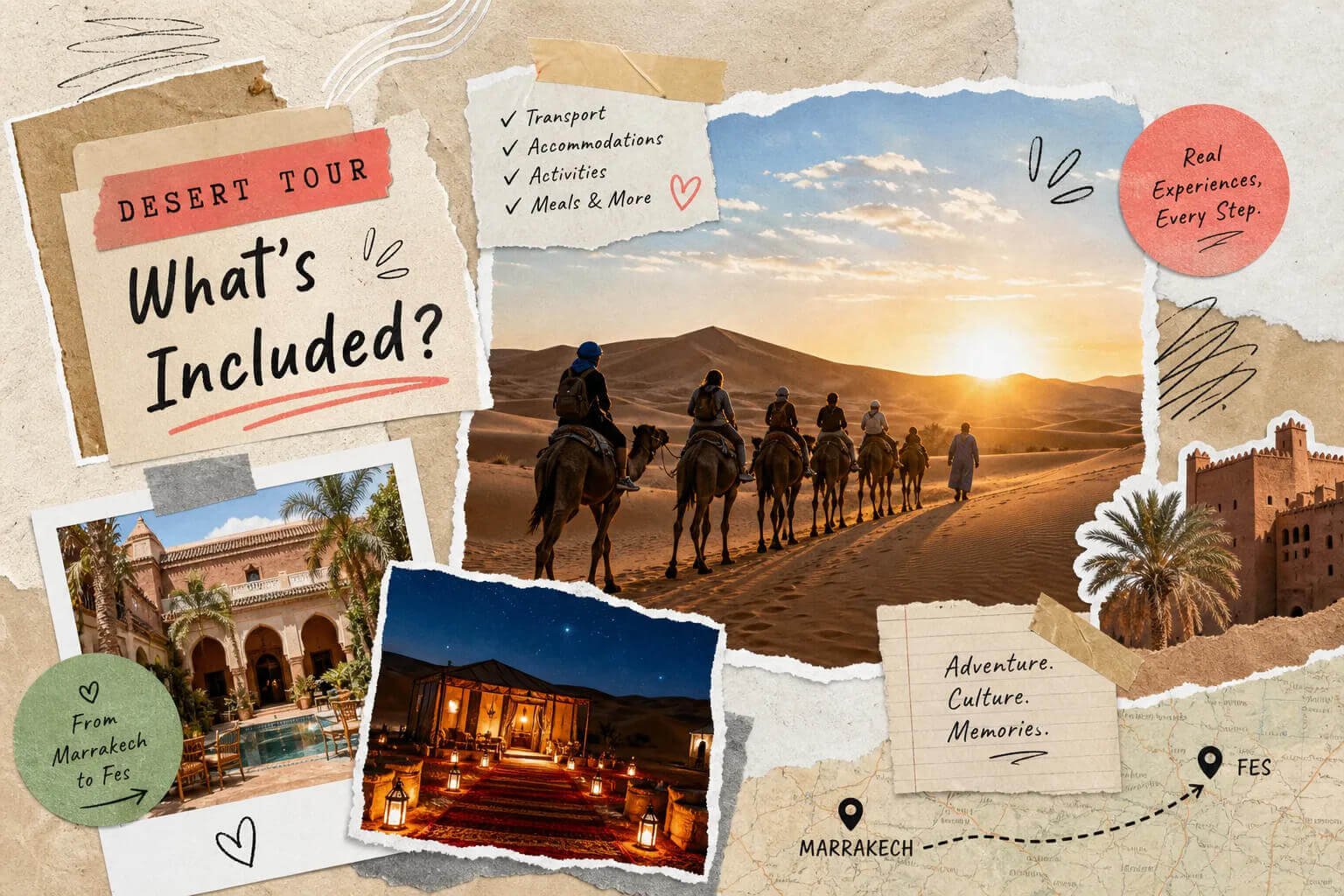
Uncover what a Marrakech to Fes desert tour offers, including camel rides, desert camps, and rich cu...
Read this article
Join our Merzouga Overnight Tour for an authentic desert experience. Enjoy camel rides, comfortable ...
Read this articleWant cool tour deals and tips about Morocco? Enter your email and we’ll send them to you each month!
