Group Tour Agencies in Morocco: How to Pick the Right One
Compare Morocco group tour agencies by trip style, reviews, pace, transport and inclusions. Learn wh...
Read this article

Private, custom Morocco trips planned in Fez by AZ-ZDDINE, working in Moroccan tourism since 2012. Sahara, Atlas, medinas and coast, arranged around you.
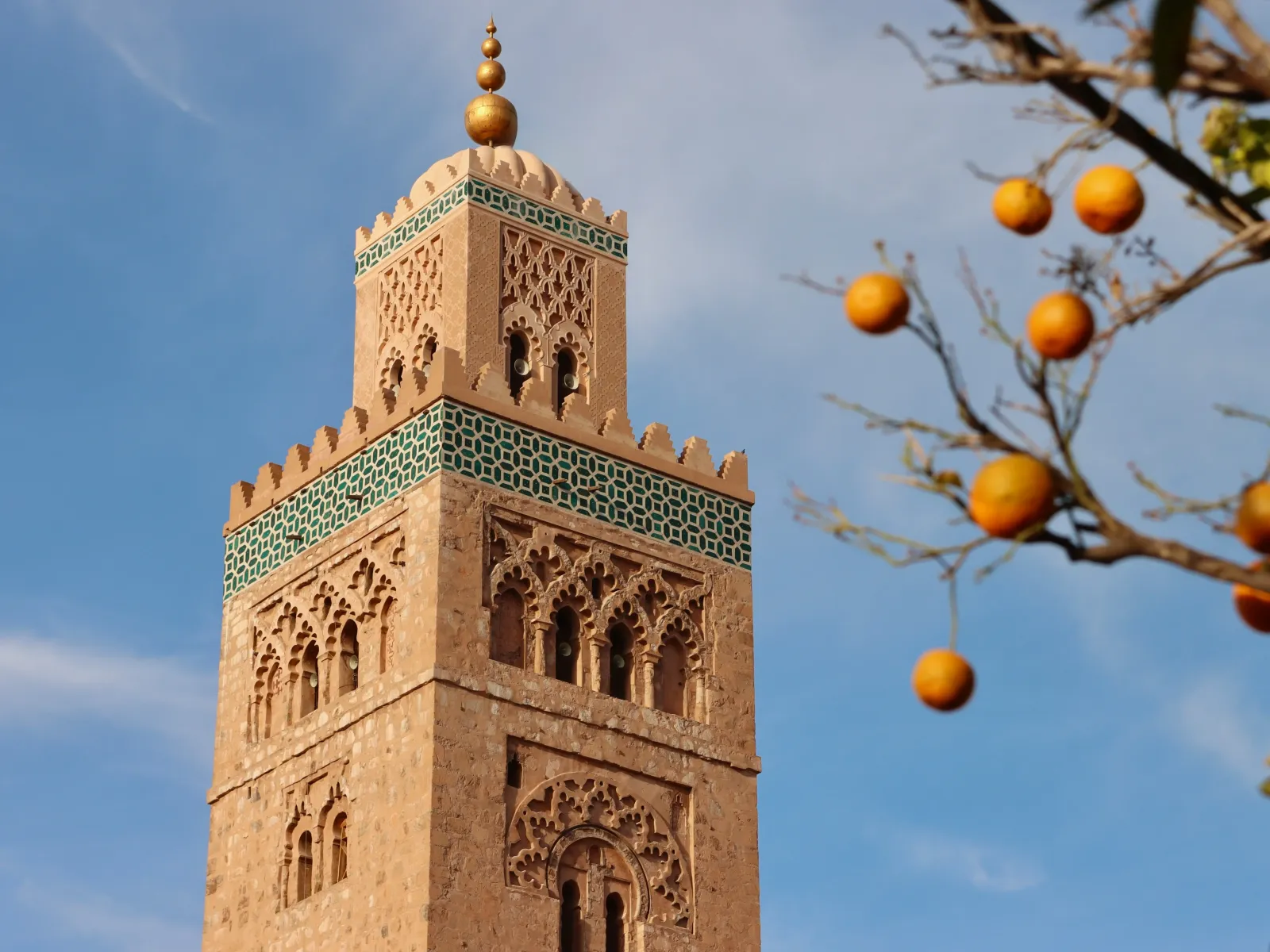
The seven saints of Marrakesh are revered 11th–16th century Islamic scholars and Sufi leaders whose tombs form a historic centuries-old annual pilgrimage around the old city of Marrakech.
The formal pilgrimage route was organized in the late 17th century by Sultan Moulay Ismail ibn Sharif to strengthen Marrakech’s spiritual prestige and rival the Regraga pilgrimage near present-day Essaouira.
Each saint—including Sidi Bel Abbas, Sidi Ben Slimane al-Jazuli, Cadi Ayyad Ben Moussad, and Sidi Youssef Ben Ali—has a distinct life story, shrine location near specific city walls and gates, and particular spiritual reputation.
Today visitors pray at each tomb location and can walk the route in one day instead of seven men’s traditional week-long journey, following local etiquette including modest dress, respectful silence, and understanding that many interior spaces have limited access for non-Muslims.
Beyond religious meaning, the Moroccan saints’ zawiyas are gateways into Marrakech’s living history, Sufi poetry traditions, and traditional neighborhoods far from the busiest tourist lanes—experiences Morocco Classic Tours can build into private Marrakech city tours.
Marrakech’s Seven Saints are seven historical Muslim figures buried in Marrakesh, Morocco, whose tombs have made the city a center of spiritual pilgrimage and cultural heritage. This guide is for travelers, history enthusiasts, and anyone interested in the spiritual heritage of Marrakech. Understanding the Seven Saints matters for appreciating the city’s culture because their legacy shapes Marrakech’s religious, social, and architectural landscape, offering insight into the city’s unique blend of spirituality and daily life.
The Seven Saints of Marrakesh are recognized as awliya, a term that refers to people who Allah has blessed with a special significance among Muslims. The concept of sainthood in Morocco differs from Western interpretations, as Moroccan saints can be rich or poor, educated or uneducated. These seven figures are venerated as spiritual protectors of the city, and the annual pilgrimage to their tombs is known as the ziyara.
The Seven Saints include Sidi Youssef Ben Ali, Cadi Ayyad Ben Moussad, Sidi Bel Abbes, Sidi Ben Slimane, Sidi Abdelaziz Tebbaâ, Sidi Abdellah El Ghazouani, and Imam Souheili. Since the 17th century, Moroccans from all walks of life have visited the graves of the Seven Saints in Marrakesh to pray to Allah. Visiting the graves is believed to heal diseases, help fulfill wishes, and provide spiritual sustenance.
In Moroccan Islam, the concept of “awliya” (friends of God) holds deep significance. These are individuals whom Allah showered with special spiritual rank—great mystics, scholars, and pious figures whose baraka (blessing) is believed to benefit those who visit their resting places. Among all the saints of Marrakech, seven particular figures emerged as the city’s spiritual protectors, transforming the metropolis into what locals sometimes call “Marrakech of the seven men.” The Seven Saints are often referred to as 'Sabatou Rijal', which translates to 'seven men'.
The seven patron saints of Marrakech are:
Saint | Arabic Name | Era |
|---|---|---|
Sidi Ben Slimane | shaykh al jazuli (Muhammad ibn Sulayman) | 15th century |
Sidi Bel Abbas | abu al abbas Ahmed al-Sabti | 12th century |
Sidi Abd el Aziz | sidi abdelaziz tabaa | 15th-16th century |
Sidi Abdallah al-Ghazwani | moul el ksour origins | 16th century |
Qadi Iyad | qadi iyad ibn Musa | 11th-12th century |
Sidi Youssef Ben Ali | moul l ghar | 12th century |
Imam al Jazuli / al Suhayli | sidi es soheili | 12th century |
(The title 'Sidi' (Arabic سيدي sayyidi) is a respectful honorific meaning 'my master' or 'sir', commonly used for saints and revered figures in North African Muslim communities.)
These figures span approximately 400 years, from the 11th through the 16th centuries. Most were scholars of the Maliki school, jurists, or Sufi shaykhs whose reputations spread across the Maghreb and al-Andalus. Their tombs form the basis of a traditional seven-day pilgrimage (ziyarah) that still shapes how locals think about their city.
From Morocco Classic Tours’ perspective, we present the patron saints both as a spiritual itinerary and as an original way for travelers to discover lesser-known corners of the medina—places where the Arabic word for blessing seems to hang in the air.
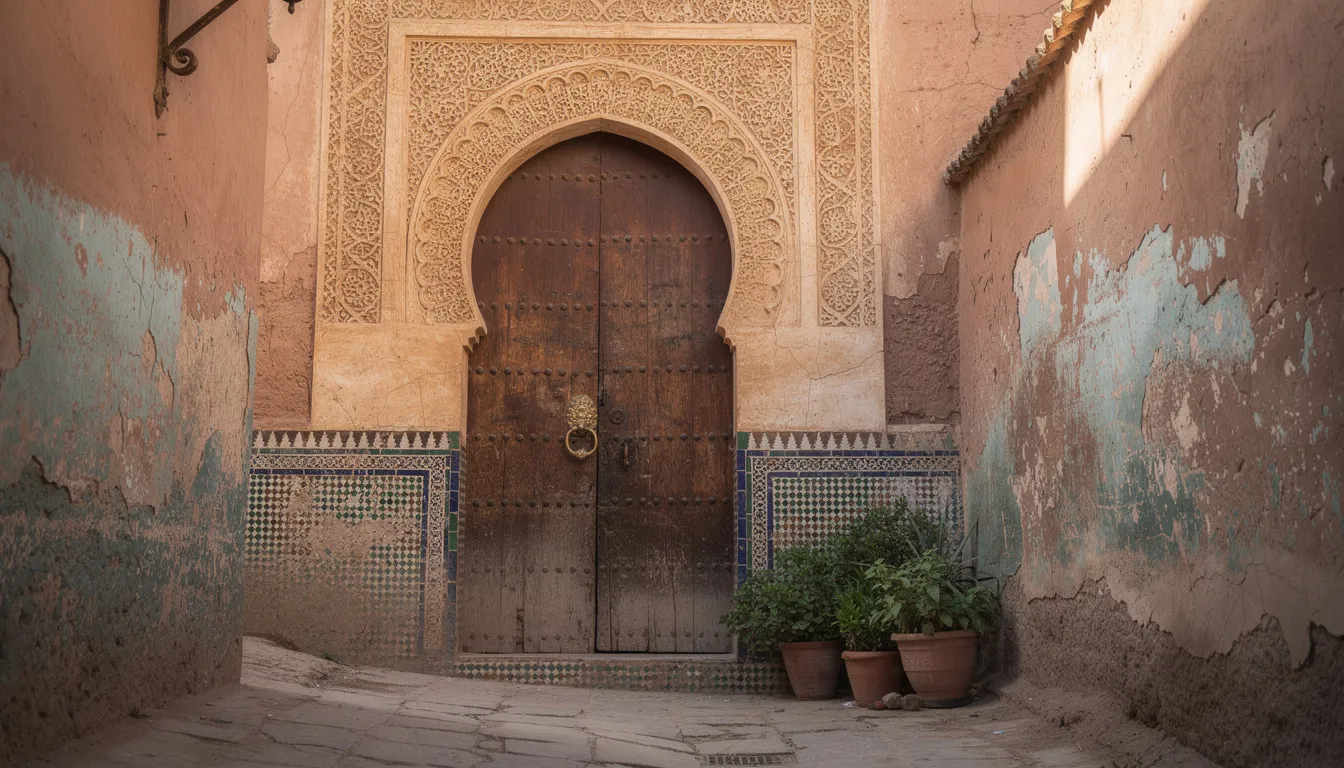
Between the 11th and 16th centuries, Morocco witnessed a flowering of Sufi spirituality. Zawiyas—Sufi lodges that served as religious schools, hospices, and community centers—became the social and spiritual hubs of urban life. The Sufi ethics of these institutions emphasized service to the poor, devotion to the Prophet ﷺ, and the cultivation of inner purity.
The saints themselves lived centuries before anyone codified their veneration into a formal circuit:
Qadi Iyad (1083–1149): The great imam and Maliki jurist from Ceuta
Sidi al Suhayli (1114–1185): The blind Andalusian scholar of Prophetic biography, renowned for his expertise in Ibn Hisham's Seerah (the biography of the Prophet Muhammad)
Sidi Bel Abbas (1129–1204): The beloved patron of Marrakech’s poor
Sidi Youssef Ben Ali (d. 1196): The patient sufferer who lived in isolation
Al Jazouli (d. 1465): Author of the beloved Dala’il al Khayrat
The formal organization of the Seven Saints pilgrimage came much later. In the late 17th century, Sultan Moulay Ismail ibn Sharif (reigned 1672–1727) commissioned a deliberate religious initiative. His motivations were explicitly political: he sought to counter the popularity of the Regraga tribe’s pilgrimage near present-day Essaouira, which celebrated seven Berber saints who had allegedly met the Prophet ﷺ.
The sultan charged Abu ‘Ali al-Hasan al-Yusi—himself of Berber origin—with instituting the new Marrakech pilgrimage. The chosen figures were largely Arabic-speaking scholars and Sufi masters, creating an implicit contrast with the Berber saints of the Regraga route. This reflected the political and cultural considerations of an era when Morocco’s religious landscape was contested between different ethnic and tribal groups.
The institutionalized pilgrimage proved mutually beneficial: it boosted Marrakech’s economy by attracting pilgrims and cemented the city’s reputation as a center of baraka across North Africa.
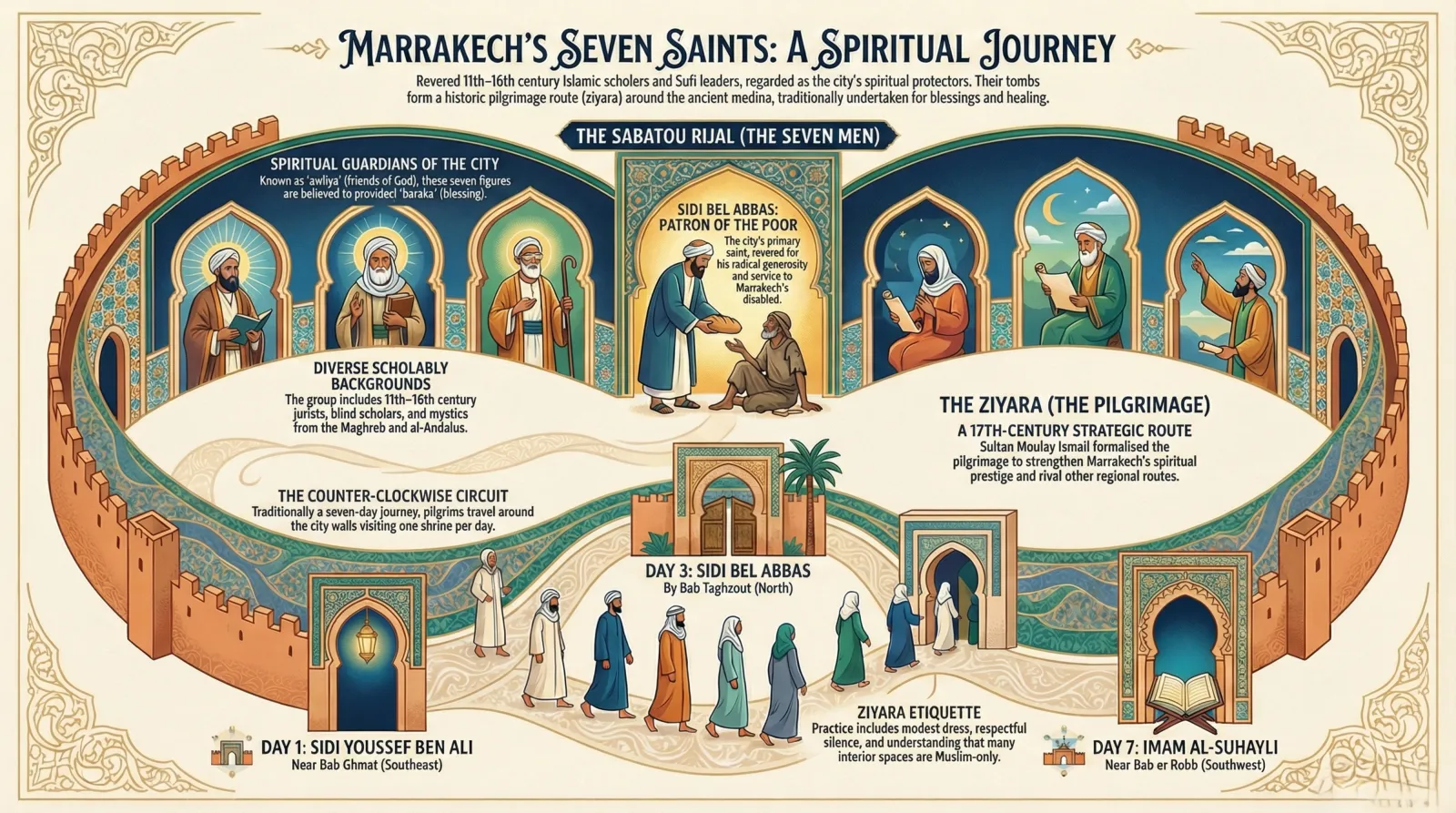
The classical ziyara lasted seven full days, with one Sufi saint visited per day. Pilgrims would move counterclockwise around the city, creating a spiritual circle encompassing the medina and its ancient gates.
Traditionally, the pilgrimage began on Tuesday and concluded on Monday. Each day focused entirely on one saint—traveling to the shrine, performing devotions, and reflecting on that figure’s life and teachings.
The historical route typically followed this sequence:
Day One: Sidi Youssef Ben Ali near Bab Ghmat in the southeast
Day Two: Qadi Iyad near Bab Aïlen
Day Three: Sidi Bel Abbas by Bab Taghzout in the north
Day Four: Sidi Ben Slimane al-Jazuli in the northern medina
Day Five: Sidi Abdul Aziz near the Ben Youssef mosque
Day Six: Sidi Abdallah al-Ghazwani near the Mouassine mosque area
Day Seven: Imam al-Suhayli near Bab er Robb in the southwest
At each tomb, pilgrims would:
Recite Qur’an, particularly read surat al-Fatiha, surat al-Ikhlas, surat Ya Seen, surat al-Sharh, and surat al-Mulk
Make du’a (supplication), asking Allah for healing, relief from hardship, and spiritual openings
Recite la ilaha illallah and prayers upon the Prophet ﷺ
Give charity to the poor who gathered near the shrines
The key theological point: visitors pray to Allah at these locations, not to the saints themselves. The shrines are understood as blessed places where pious people rest—locations where prayers may be more readily answered.
Most Moroccans no longer take seven full days for the circuit. However, some families and Sufi groups still follow the sequence over one or two days, especially during spring months and religiously significant periods.
Modern visitors can walk a condensed version in about four to six hours. Morocco Classic Tours can adapt the route to guests’ interests and walking pace, creating either a half-day overview or a full-day immersive experience.
If you’re entering a mosque or zawiya as a Muslim visitor:
Perform two rak’at of salat al-tahiyya (greeting prayer) when possible
Stand respectfully near the tomb chamber without pressing against it
Recite surahs such as al-Fatiha, al-Ikhlas, Ya-Sin, and make du’a for yourself and the community
Traditional Sufi practice includes gifting the spiritual reward of recitation to the Prophet ﷺ, the saint, and all the awliya before making personal supplication
Consider giving small charity nearby where distribution points exist
Many zawiyas and mosques in Marrakech restrict entry to inner prayer halls for Muslims only. However, you can still experience meaningful aspects of the tradition:
Walk to each neighborhood and observe the exterior architecture
Experience the surrounding life of the medina and traditional quarters
Photograph from courtyards and permitted areas (away from people at prayer)
Respect any “Muslims Only” signs and follow caretaker guidance
Dress and Behavior Table:
Do | Don’t |
|---|---|
Cover shoulders and legs | Use flash photography inside |
Women: bring headscarf for religious spaces | Point cameras at worshippers |
Speak in quiet voices | Photograph royal facilities near Bab Agnaou |
Remove shoes when required | Treat ceremonies as performances |
Ask permission before photographing people | Rush through spaces |
Use Google Maps or an offline map app
Learn key gate names: Bab Ghmat, Bab Taghzout, Bab Aïlen, Bab er-Robb
Avoid unsolicited “faux guides” who may demand payment
Morocco Classic Tours provides licensed local guides familiar with the shrines and their stories—a short walk with an expert beats hours of confusion
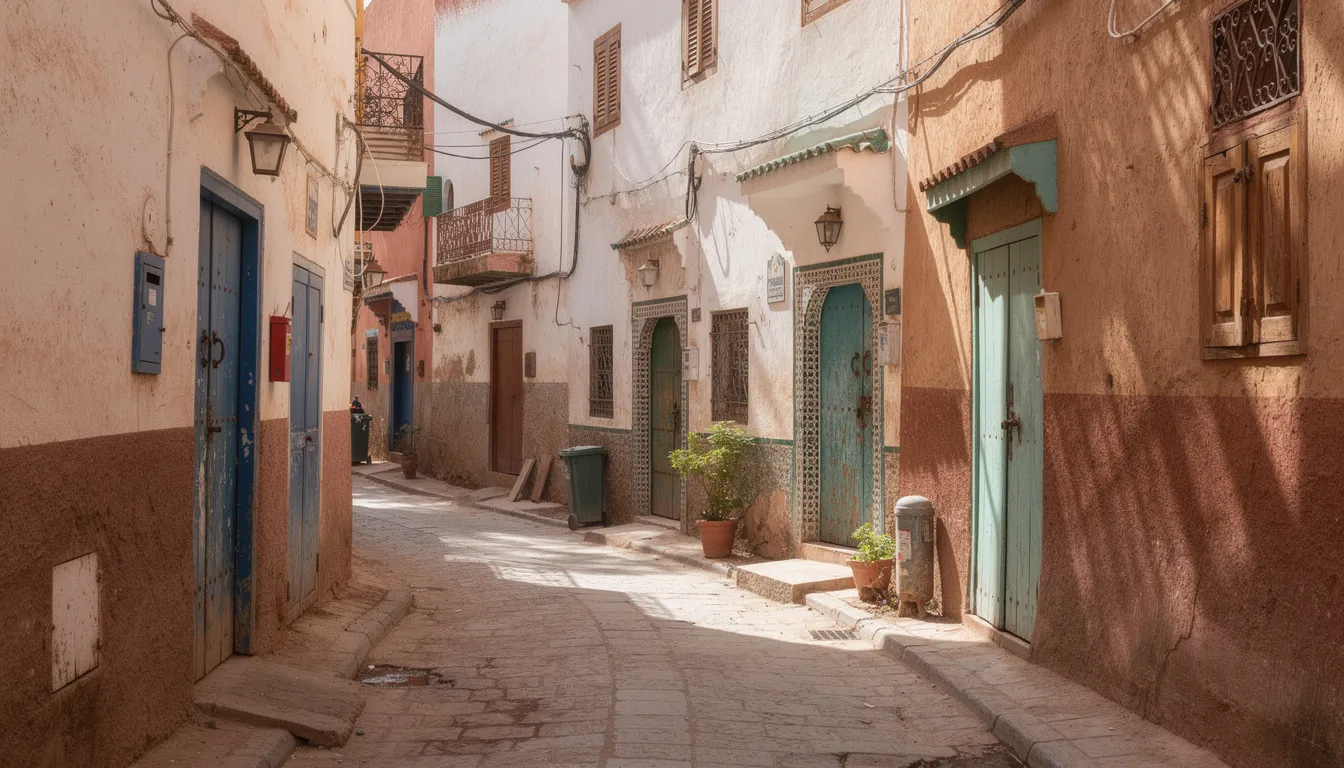
This section presents concise portraits of each saint: their life, teachings, and the location and character of their shrine today. The order follows roughly historical chronology rather than the walking order of the ziyara, helping you situate each figure in time.
The name Qadi Iyad commands instant respect among scholars of Islamic jurisprudence. Born in Ceuta (Sebta) on the Strait of Gibraltar in 1083, he became one of the most influential Maliki jurists and hadith scholars in the western Islamic world, his speciality being jurisprudence and Prophetic traditions.
Life and Scholarship
Qadi Iyad served as a high judge (qadi) in Granada under the Almoravid dynasty. His reputation combined rigorous legal expertise with deep, passionate love for the Prophet ﷺ. Students visited Morocco from across the Muslim world to study with him.
His most famous work, al-Shifa bi-Ta’rif Huquq al-Mustafa (The Cure Through Knowledge of the Rights of the Chosen One), remains a classic text on the virtues of the Prophet ﷺ. It continues to be read in Moroccan mosques and zawiyas to this day.
The Shrine
Qadi Iyad died in 1149 and is buried just outside Marrakech near Bab Aïlen. The modern tomb building stands in a simple urban setting along Avenue Qadi Iyad, with limited exterior decoration—reflecting his status as a jurist and scholar more than a miracle-working saint. Scholars, students, and ordinary believers visit regularly.
If any single figure embodies Marrakech’s spiritual identity, it is Belabbas Ahmed Sebti—Sidi Bel Abbas. Often considered the city’s primary patron saint, his legacy of radical generosity continues to shape Marrakech’s charitable traditions.
Life and Legacy
Abu al-Abbas Ahmed ibn Ja’far al-Khazraji al-Sabti was born in Ceuta in 1129 and later moved to Marrakech. He became known for feeding the poor and disabled, insisting that “existence is by generosity.” His motto was not mere philosophy—he lived it absolutely.
For a time, Sidi Bel Abbas lived in seclusion in a cave outside the city walls. He later became associated with the Almohad sultan Yacoub el Mansour, who supported both the sheikh intervened for the poor and the communities he served. Yacoub el Mansour brought resources to sustain this work.
The Shrine
Sidi Bel Abbas died in 1204 and is buried at the Sidi Marouk cemetery near Bab Taghzout. His large zawiya remains one of the key spiritual centers of Marrakech. Food distribution and charity still occur at his shrine—you may see people receiving meals as you visit.
For visitors, the complex is one of the busier and more architecturally impressive stops on the Saints circuit, with courtyards and traditional Moroccan religious architecture.
The scholar Sidi Es Soheili represents the profound intellectual exchange between al-Andalus and Morocco during the 12th century—a bridge between Iberian and North African Islamic culture.
Life and Scholarship
Born near Málaga in al-Andalus around 1114, al Suhayli was blind from birth. Despite this, he received an exceptional education from prominent Andalusian scholars in Qur’an, Arabic grammar, and theology.
His masterwork was a seven-volume commentary on Ibn Hisham’s seerah (the biography of the Prophet ﷺ). This detailed analysis of the Prophet’s life established him as one of the foremost scholars of Prophetic biography in his era.
Imam al-Suhayli was invited to Marrakech by Yacoub el Mansour, reflecting the city’s role as a cultural bridge during the Almohad period. He accepted and spent his final years in the city.
The Shrine
He died in 1185 and is buried outside the southwestern walls near Bab er Robb, not far from Bab Agnaou and the royal palace district. His tomb lies in a quieter area than some other saints. The atmosphere tends toward the reflective, with caretakers often reciting Qur’an.
Note: Visitors must be careful not to photograph palace structures in this area—security is attentive.
Among the seven patron saints, Sidi Youssef Ben Ali holds a special place in Marrakech’s heart. His story is one of suffering transformed into spiritual beauty.
Life and Trials
A native of Marrakech of Yemeni ancestry, Sidi Youssef Ben Ali was afflicted with leprosy—a condition that forced him into severe social isolation. He lived in a cave outside the city walls, earning the nickname moul l ghar (the man of the cave).
Despite his exclusion from ordinary society, people sought him out for advice and blessings. He studied under local shaykhs such as Abu Asfour and became a symbol of patience, endurance, and inner beauty. His life demonstrated that physical suffering cannot diminish spiritual rank.
The Shrine
Sidi Youssef Ben Ali died in 1196 and was later reinterred just outside Bab Ghmat (Bab Aghmat) southeast of the medina. His zawiya today is surrounded by modern neighborhoods and shops—a living part of the city rather than an isolated monument.
His shrine traditionally forms the starting point of the Seven Saints ziyara, setting a tone of humility and resilience for the entire pilgrimage.
Perhaps no figure among the Seven Saints has had wider influence than Shaykh al Jazuli. His spiritual writings reached from Morocco to Indonesia, touching Muslims across the globe.
Life and Spiritual Journey
Born in the 15th century in a village called Jazoula in the Souss (Souss Massa Daraa region south of Marrakech), al-Jazuli began his studies locally before traveling to Fes for advanced education.
A famous story captures his spiritual turning point: at a well, he encountered a young girl who could draw water miraculously through her spiritual state. When asked about her secret, she remarked on his inability to achieve what her devotion made possible. This encounter inspired him to deepen his spiritual path dramatically.
Authoring Dala’il al-Khayrat
His masterwork, authoring Dala’il al Khayrat (Proofs of Kindness), is a collection of prayers and blessings upon the Prophet ﷺ compiled around the mid-15th century. The text became one of the most widely recited devotional works in Islamic history, found from Morocco to Malaysia. The al Khayrat tradition he established continues in gatherings across the Muslim world.
Death and Transfer
The shaykh passed in 1465 during the Fajr prayer. He was initially buried in the Souss region, but decades later his body was found miraculously preserved. Under Saadian patronage, his remains were transferred to Marrakech.
The Shrine
The zawiya of Sidi Ben Slimane lies in the northern medina near Dar el Glaoui and the mosque that bears his name. It remains a peaceful refuge where the Dala’il al-Khayrat is recited weekly, especially on Thursdays. The spiritual successor traditions he founded continue there today.
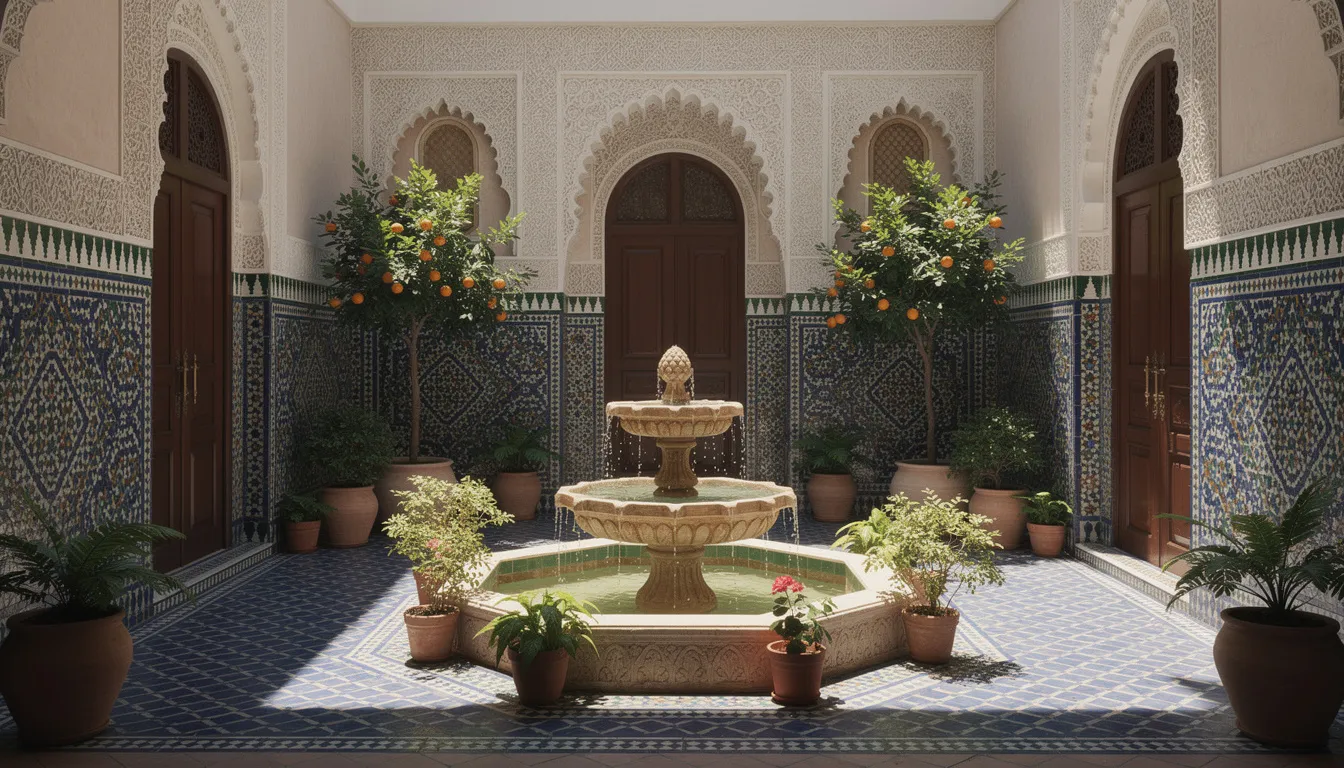
The figure of Sidi Abdelaziz Tabaa represents a bridge between the scholarly and mystical traditions of Marrakech’s Seven Saints.
Life and Path
Abou Fares Abdelaziz was originally a silk merchant from Fes. His business brought material success, but his soul sought something deeper. He became a close disciple and spiritual successor of Sidi Ben Slimane al-Jazuli. For those visiting Morocco and seeking unique experiences, consider exploring the Agafay Desert tours near Marrakech.
After al-Jazuli’s passing, Abou Fares moved to Marrakech, helping to root the Shadhili-Jazuli Sufi path in the city. He attracted circles of disciples and established a zawiya that became central to Marrakech’s spiritual life.
The Shrine
Abdul Aziz died in 1508 and is buried near the Ben Youssef mosque in the heart of the medina. This makes his zawiya one of the most centrally located of the Seven Saints—convenient for visitors exploring the main tourist areas.
The zawiya features a modest street entrance leading to an interior courtyard with a fountain and the tomb chamber. This is typical of traditional Moroccan religious architecture that hides its beauty behind discreet doors.
The final figure in our chronological survey, Sidi Abdallah al-Ghazwani, completed the chain of transmission that brought Jazuli Sufism to full flower in Marrakech.
Life and Education
Moul el Ksour origins trace to the Gazouna tribe. He studied in both Fes and Granada, reflecting the interconnected scholarly world of Morocco and al-Andalus that persisted even as Iberian Muslim civilization faced its final centuries.
He completed his spiritual training under Sidi Abd el Aziz Tebba’ in Marrakech and became one of the principal shaykhs of the Shadhili-Jazuli order in the city.
The Shrine
Sidi Abdallah died in 1528 and is buried near the Mouassine mosque in the central ksour (quarters) of the medina. His location earned him the nickname “Moul el-Ksour” (Lord of the Quarters).
His zawiya is relatively spacious and often busy, serving as an important spiritual and social hub for the surrounding neighborhood. It’s not always clearly marked on tourist maps—another reason why Morocco Classic Tours’ licensed guides and Morocco tours for seniors prove valuable.
Some traditional Seven Saints routes end or begin here when sequences are adapted. The Mouassine area also offers excellent opportunities to explore nearby fountains and souks.
While the classic ziyara was religious in nature, contemporary visitors—Muslim and non-Muslim—often follow the route as a cultural walking tour through authentic districts of Marrakech.
Here’s a suggested route for modern visitors:
Start: Bab Ghmat area → Sidi Youssef Ben Ali
Continue north: Bab Aïlen → Qadi Iyad
Northern medina: Bab Taghzout → Sidi Bel Abbas
Continue: Sidi Ben Slimane al-Jazuli area
Central medina: Near Ben Youssef → Sidi Abd el-Aziz
Mouassine quarter: Sidi Abdallah al-Ghazwani
Finish: Bab er-Robb / southern gate area → Imam al-Suhayli
Tour Type | Duration | Best For |
|---|---|---|
Quick overview | 3-4 hours | Time-limited visitors wanting highlights |
Standard tour | 5-6 hours | Most visitors seeking balanced experience |
In-depth exploration | Full day | Those interested in deeper spiritual/historical content |
The full-day option allows for longer stops, photography sessions, tea breaks, and more in-depth spiritual practices at each location.
Morocco Classic Tours can integrate this route into a private Marrakech city tour, combining it with landmarks such as:
Jemaa el-Fnaa square
Ben Youssef Madrasa
The Koutoubia area
Artisan quarters and traditional souks
This creates a balanced experience mixing spiritual heritage with the city’s other attractions.
For travelers interested in Sufism, consider scheduling visits on:
Thursday evenings: When recitations and gatherings are more frequent
Religious occasions: Mawlid (Prophet’s birthday), Ramadan periods
Spring months: When some families still observe traditional pilgrimage customs
Remember to respect local customs and not treat ceremonies as performances for tourist entertainment.
We design tailor-made itineraries for guests who want to add a spiritual and historical dimension to their time in Marrakech. The Seven Saints circuit offers something that standard city tours simply cannot—access to the authentic religious and cultural heart of the city.
Half-Day Private Tour
Meet at Café Koutoubia as a convenient starting point
Visit 3-4 selected saints’ zawiyas with a licensed local guide
Hear stories of each saint’s life and legacy
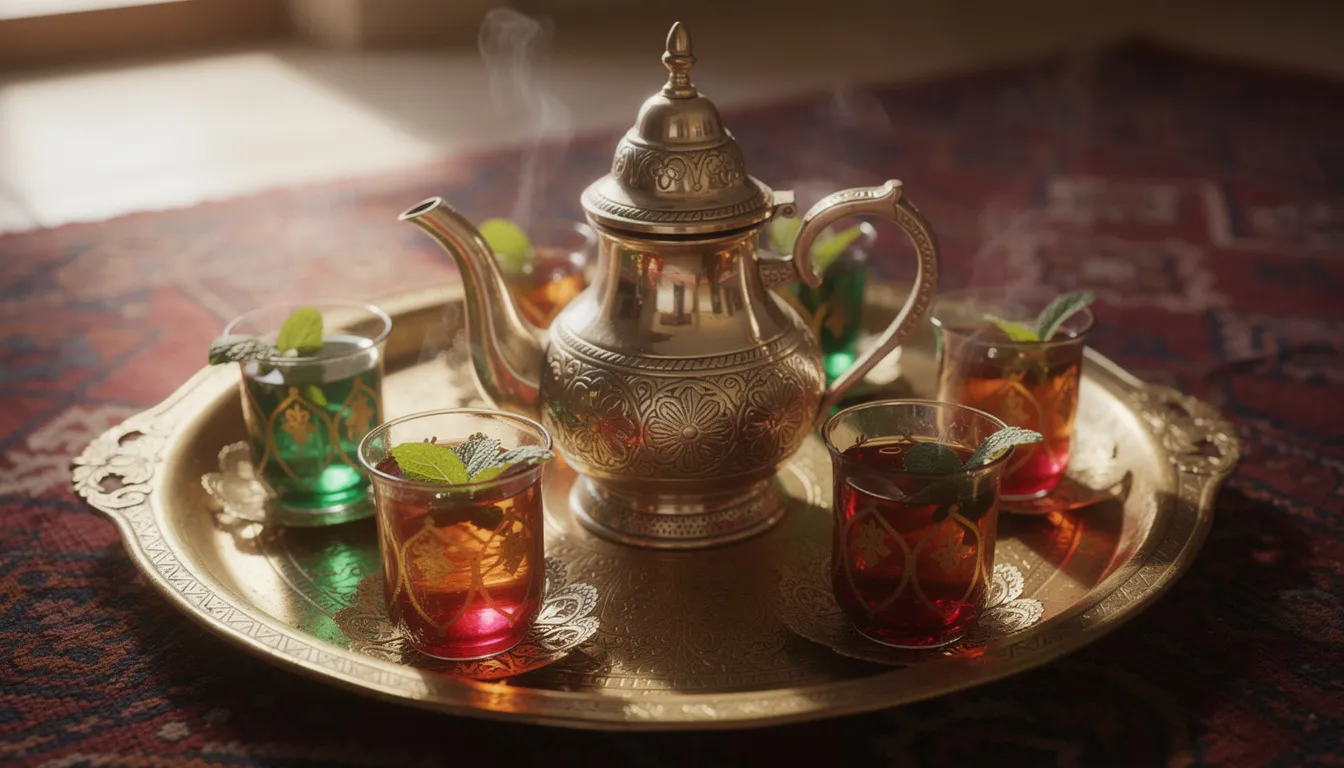
Include time for tea and brief souk exploration
Duration: 4 hours approximately
Full-Day Immersive Experience
Complete circuit of all seven sites
Deeper historical and spiritual context at each location
Multiple tea breaks and lunch in a traditional setting
Extended time for photography and neighborhood exploration
Duration: 7-8 hours
We can arrange additional religious elements for observant Muslim guests:
Time for prayers at appropriate intervals
Guided Qur’an recitation at shrine locations
Attending a Dala’il al-Khayrat gathering where appropriate
Coordination with local religious schedules
The emphasis shifts to:
Architecture and urban history
Understanding Sufi culture and traditions
Photographing historic quarters
Experiencing authentic neighborhood life
Learning about Morocco’s religious heritage respectfully
Access rules to mosques and shrines are always observed.
The Seven Saints circuit can connect beautifully with Morocco Classic Tours’ broader offerings:
Atlas Mountains day trips: Contrast urban spirituality with mountain landscapes
Sahara desert camps: Experience Morocco’s mystical desert traditions
Imperial cities journeys: Link Marrakech’s saints with Fes’s spiritual heritage
Contact us via our website to customize your Marrakech stay and create an itinerary that balances the Seven Saints with whatever else calls to you in Morocco.
Non-Muslims are generally welcome to walk to the neighborhoods of each zawiya, see exteriors, and experience the surrounding life of the medina. Many mosque prayer halls in Morocco, including some zawiya interiors, are reserved for Muslims only. Access policies vary by site and can change over time.
We recommend respecting any “Muslims Only” signs, following caretaker guidance, and enjoying the cultural and historical aspects from permitted areas. Even exterior visits provide meaningful context for understanding Marrakech’s spiritual geography.
The route can be walked year-round, but spring (March–May) and autumn (late September–November) offer more comfortable temperatures for extended walking through the medina.
Religious gatherings may be more frequent around Ramadan, Mawlid (the Prophet’s birthday), and local festival periods, though opening hours can also be more irregular then. During summer, start early in the morning to avoid midday heat, and bring water, sun protection, and comfortable footwear.
The traditional ziyara lasted seven days, with one saint visited each day and ample time for worship and reflection. Modern visitors typically complete a walking circuit in about four to six hours, depending on pace, time inside each zawiya, and breaks for food or shopping.
Morocco Classic Tours usually suggests a half-day overview (3-4 hours) or a full-day in-depth exploration (7-8 hours), adjusted to the traveler’s interests and mobility.
It is possible to reach many of the shrines independently using a good offline map and basic knowledge of city gates. However, streets can be confusing and signage scarce. You may also encounter unofficial “guides” who demand payment for unwanted assistance.
A licensed local guide offers accurate storytelling, safer navigation, and knowledge of which areas are open to which visitors. Morocco Classic Tours works with certified guides who specialize in Islamic history and Sufi culture for guests seeking deeper understanding.
Absolutely. Even a two- or three-night stay provides enough time to sample several saints’ shrines as part of a broader city tour. Those with very limited time can focus on two or three centrally located sites—such as Sidi Abd el-Aziz, Sidi Abdallah al-Ghazwani, and Sidi Ben Slimane—combined with main medina highlights.
Travelers with longer itineraries in Morocco can link Marrakech’s spiritual heritage with visits to Fes, the Atlas Mountains, and the Sahara Desert for a fuller picture of the country’s religious and cultural landscape.
Compare Morocco group tour agencies by trip style, reviews, pace, transport and inclusions. Learn wh...
Read this article
Uncover what a Marrakech to Fes desert tour offers, including camel rides, desert camps, and rich cu...
Read this article
Join our Merzouga Overnight Tour for an authentic desert experience. Enjoy camel rides, comfortable ...
Read this articleWant cool tour deals and tips about Morocco? Enter your email and we’ll send them to you each month!
