Group Tour Agencies in Morocco: How to Pick the Right One
Compare Morocco group tour agencies by trip style, reviews, pace, transport and inclusions. Learn wh...
Read this article

Private, custom Morocco trips planned in Fez by AZ-ZDDINE, working in Moroccan tourism since 2012. Sahara, Atlas, medinas and coast, arranged around you.
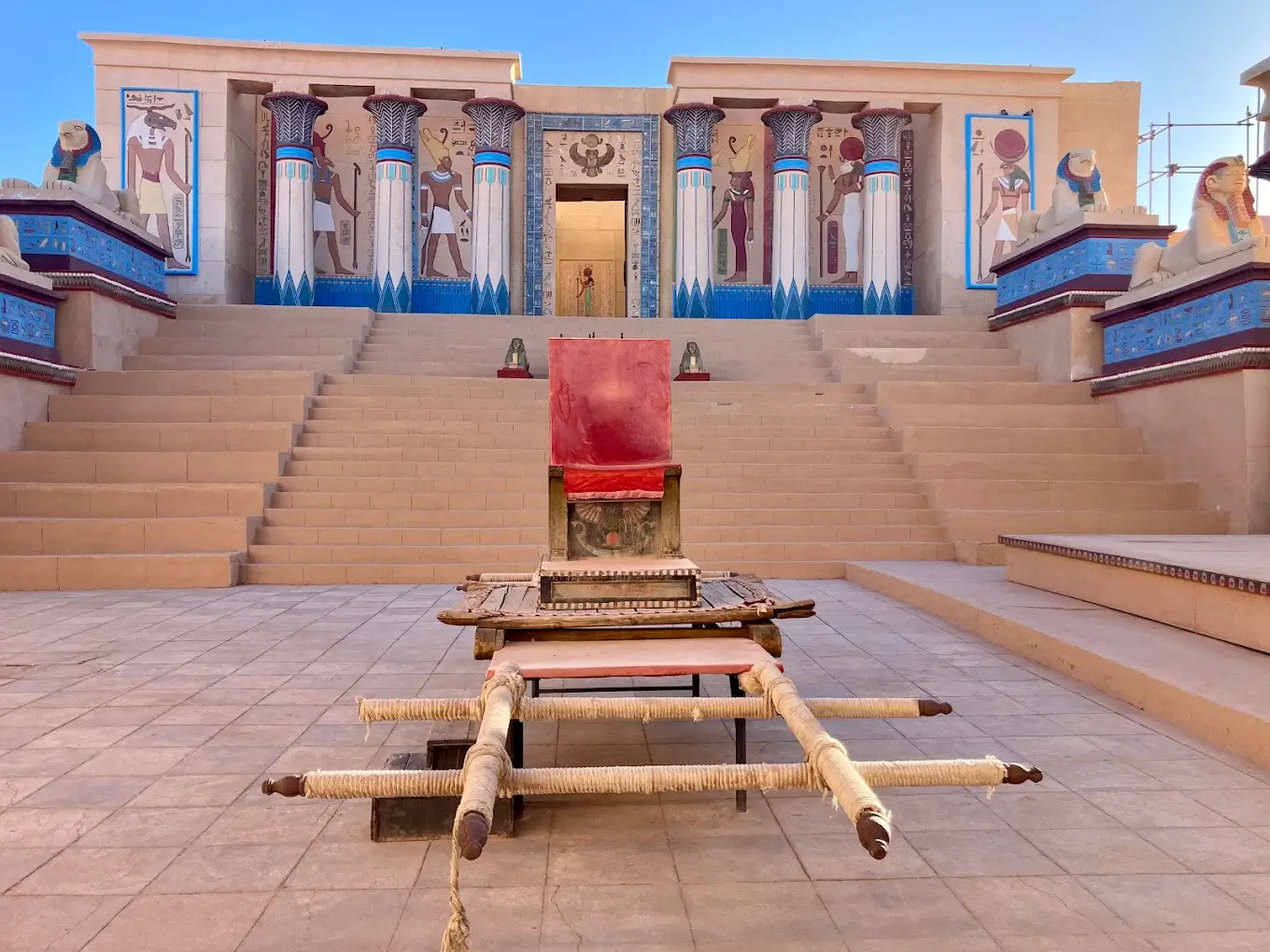
Ouarzazate sits at the crossroads of everything that draws travelers to southern Morocco: dramatic kasbahs, legendary film studios, and open routes leading deep into the Sahara. This compact desert-edge city has quietly served as a staging ground for Hollywood productions and Saharan adventures alike for decades.
Ouarzazate is located in south-central Morocco at around 1,160 m elevation on the southern side of the High Atlas Mountains, with postcode 45000. Pronounce it “war-za-zat” with stress on the final syllable—the ending “e” is silent.
What makes it famous: Gateway to the Sahara Desert, home to Atlas Film Studios and the smaller CLA Studios (earning it the nickname “Little Hollywood”), proximity to the UNESCO-listed Ksar Ait Ben Haddou, and historic kasbahs like Taourirt and Tifoultoute.
Is it worth visiting? Yes, especially if you enjoy film history, desert landscapes, and mudbrick architecture. Plan for at least 1 night to see the highlights; 2 nights allow time for day trips to Aït Ben Haddou, Fint Oasis, or the Dades Valley. If your priority is atmosphere and photography, stay near Aït Ben Haddou; if you need services and flexibility for multiple excursions, base yourself in Ouarzazate city.
Best time to visit: March through May and September through November offer wonderfully pleasant temperatures (20–28°C days). Summer brings extreme heat above 35°C, while winter days stay mild but nights drop near freezing.
Morocco Classic Tours is a local Morocco-based agency that can organize private transfers from Marrakech, guided visits to studios and kasbahs, desert camps, and Atlas Mountains hiking tours starting or stopping in Ouarzazate.
Ouarzazate is a calm, sun-baked city in south-central Morocco that serves as a natural junction between the High Atlas Mountains and the vast desert regions to the south. Often called the “Door of the Desert” and “Little Hollywood,” it feels like a frontier town where adventure begins.
The city lies roughly 200 km southeast of Marrakech—about 4 hours by road via the Tizi n’Tichka Pass—and approximately 440–450 km from Casablanca. It belongs to the Drâa-Tafilalet region, and its official mailing address is Ouarzazate 45000, Morocco.
At an elevation of around 1,160 m (3,800 ft), Ouarzazate occupies the southern slopes of the High Atlas, positioned at the junction of routes leading to:
The Drâa Valley (toward Zagora and M’Hamid)
The Dades Valley and Todra Gorge (toward Tinghir and eventually Merzouga)
The Moroccan Sahara via multiple southern and eastern routes
A century ago, Ouarzazate was little more than a kasbah and oasis settlement. During the French Protectorate, it developed into a garrison town around 1932 and has since grown into a regional hub with wide avenues, government offices, and its own international airport located about 3 km from the city center.
The name itself comes from a Berber phrase often interpreted as “without noise” or “quiet place”—a fitting description of its historical role as a peaceful caravan crossroads, far from the bustle of the northern imperial cities.
The spelling looks intimidating to most people encountering it for the first time, but pronunciation is straightforward once you break it down.
Say it as “war-za-zat”—three syllables, with the stress on the final syllable. The “oua” sounds like the English word “war,” the “za” sounds like the “za” in pizza, and “zat” rhymes with “cat.” The final “e” is completely silent.
For those who prefer phonetic notation: /war-za-ZAT/.
Travelers often pick up the correct pronunciation naturally at bus stations or taxi ranks. Asking a local to repeat it slowly works as a friendly icebreaker and usually earns a smile.
Using the correct pronunciation helps practically, whether you’re buying CTM bus tickets at the Marrakech station, arranging a grand taxi, or booking tours with local agencies like Morocco Classic Tours that operate routes through the city.
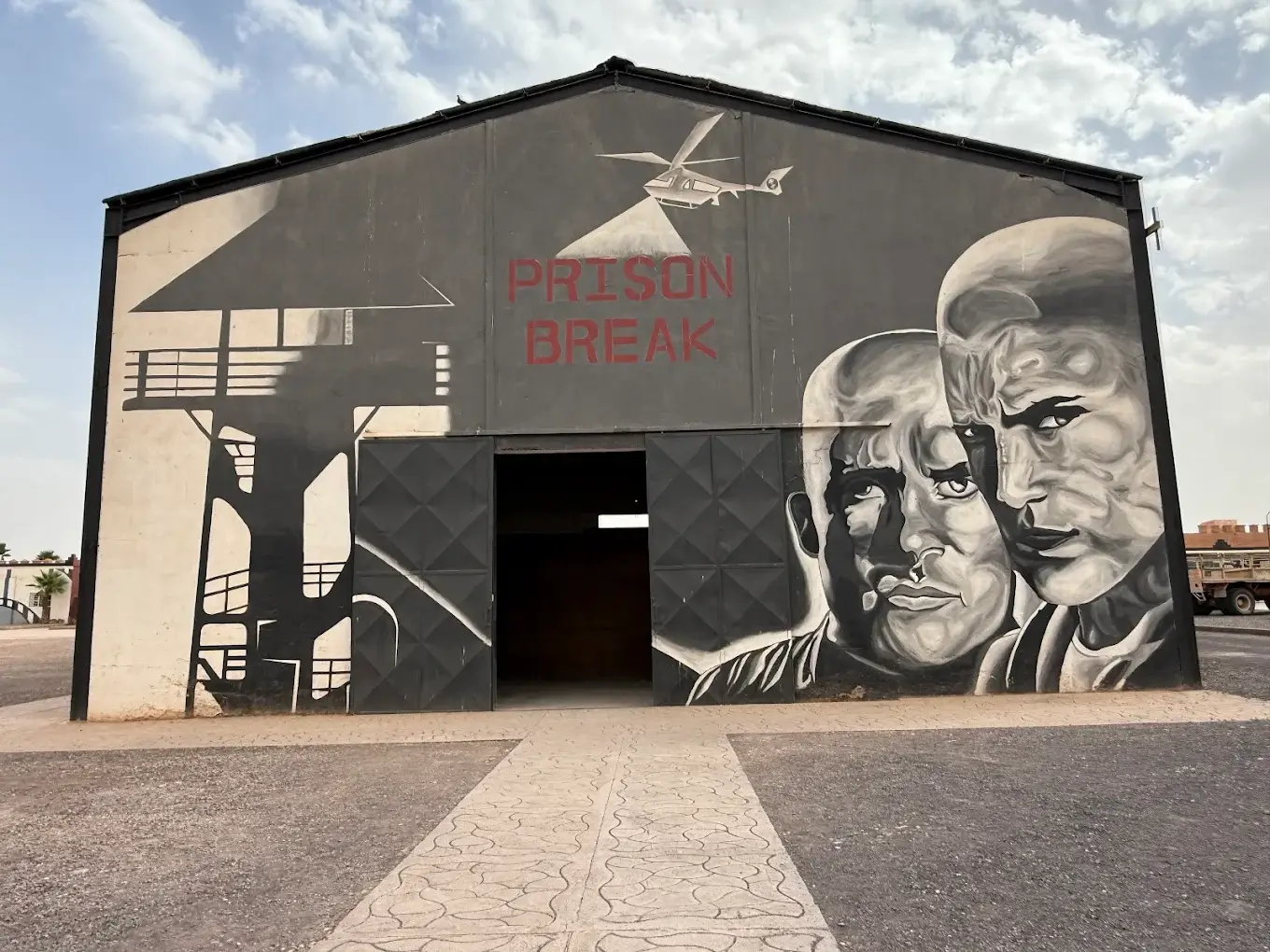
Ouarzazate’s identity rests on four distinct pillars: cinema and film productions, its role as a gateway to the desert, traditional kasbah architecture, and renewable energy innovation.
The city earned its “Little Hollywood” nickname honestly. Atlas Studios and CLA Studios have hosted film productions since the 1960s, drawing directors who discovered the region’s combination of dramatic landscapes, traditional mudbrick architecture, reliable sunshine, and relatively low production costs. Many streets, hotels, and cafes in town reference this film culture, displaying movie posters and reel-themed decor.
The list of Hollywood blockbusters and international productions filmed here is extensive:
Film/Series | Year | Notable Use |
|---|---|---|
Lawrence of Arabia | 1962 | Desert and fort sequences |
The Man Who Would Be King | 1975 | Atlas and desert landscapes |
The Jewel of the Nile | 1985 | Desert environs |
The Mummy | 1999 | Egyptian city and desert scenes |
Gladiator | 2000 | Roman North Africa, “Zucchabar” |
Kingdom of Heaven | 2005 | Crusader-era Jerusalem sets |
Babel | 2006 | Moroccan storyline |
Martin Scorsese’s Kundun | 1997 | Tibetan temple and palace sets |
Game of Thrones | 2013 | Aït Ben Haddou as Yunkai |
Prison Break | 2017 | Middle Eastern war-torn urban scenes |
Sets from many of these productions remain at Atlas Studios and the movie studios around town, available for tourist visits. | ||
Architecturally, Ouarzazate anchors one end of the famous Route of a Thousand Kasbahs extending through the Dades and Drâa valleys. Key landmarks include:
Taourirt Kasbah – The city’s signature 18th-19th century fortress, once a stronghold of the powerful Glaoui family
Ksar Aït Ben Haddou – A UNESCO World Heritage Site 30 km away, featured in countless films
Tifoultoute Kasbah – Perched above the Drâa Valley with panoramic sunset views
Telouet Kasbah – The grand, partially ruined palace of the Glaoui family along the old caravan road to Marrakech
On the city’s outskirts, the Noor Ouarzazate Solar Complex stands as one of the world’s largest concentrated solar power plants. With a total capacity of around 580 MW, it symbolizes Morocco’s ambitious renewable energy goals and its position as a leader in North Africa for sustainable development.
Worth mentioning: the search phrase “ouarzazate morocco dust 2” reflects how the city’s sun-bleached walls, narrow alleys, and dusty plazas increasingly remind gamers of iconic first-person shooter maps. The ochre tones, rooftop vantage points, and desert aesthetics resonate with gaming culture in unexpected ways.
Ouarzazate itself is compact and walkable, especially around Avenue Mohammed V and Avenue Mohammed VI, where cafes and everyday shops cluster. However, many key sites lie within a 20–45 minute drive, best explored with a car, private driver, or organized desert tour.
Taourirt Kasbah. This adobe fortress dates to the 18th-19th century and served as a stronghold for the Glaoui family, who controlled much of southern Morocco during the late pre-colonial and colonial periods. Partially restored, it features labyrinthine corridors, internal courtyards, and carved plaster interiors. Entry costs around 30 MAD, and hiring a licensed guide on-site adds valuable context about Saharan trade routes and the Glaoui legacy. Plan for 1–1.5 hours.
Ksar Taourirt. The surrounding area of the kasbah is an old quarter with narrow alleys, mud-brick houses, and local life unfolding in doorways and small workshops. Wander respectfully or join a short guided walking tour for context on traditional urban design.
Cinema Museum Opposite Taourirt Kasbah, housed in a former studio building, this museum displays old cameras, film props, costumes, and reconstructed heaven set pieces from biblical epics and sword-and-sandal productions. Expect to spend 45–60 minutes here if you’re a film fan.
Place Al-Mouahidine and Avenue Mohammed V Stroll or settle into a cafe for mint tea at this central square. The surrounding streets host bakeries, patisseries, and everyday services—a less-touristy feel compared with Marrakech’s medina.
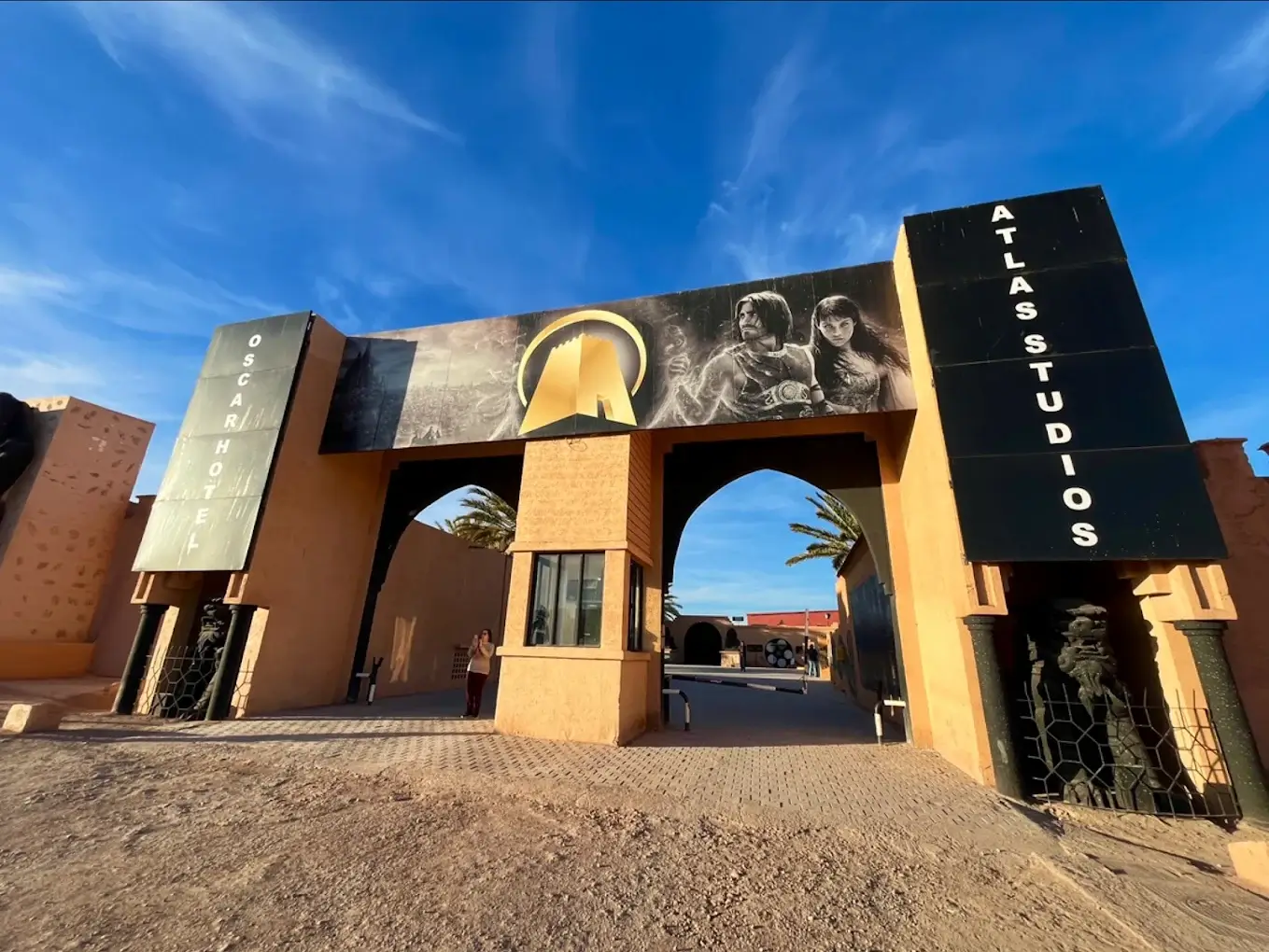
Atlas Film Studios, located just outside town (about 4–5 km toward Skoura), ranks among the largest studio complexes in the world by area. The main studio offers guided tours lasting roughly 2 hours, walking visitors through outdoor sets representing ancient Egypt, biblical Jerusalem, Roman amphitheaters, and generic Middle Eastern marketplaces. Entrance typically runs 80–110 MAD per adult. Many movie sets from Gladiator and Kingdom of Heaven remain as photo opportunities.
CLA Studios The smaller CLA Studios sit closer to town along the road toward Aït Ben Haddou. They’re appealing for travelers without much time or transport, though sets change frequently depending on current productions. Both facilities welcome visitors and reinforce why Ouarzazate earned its reputation as a filming location.
Fint Oasis About 15 km south of town, Fint Oasis comprises four small villages nestled in a green valley where a small river supports date palms, crops, and grazing animals. Access via rough desert tracks requires a 4x4 or an experienced local driver, especially after rain. Visitors can walk along the riverbed, observe traditional irrigation channels, and have lunch at a local auberge. Half-day visits work well, or spend a full day with longer hikes into side valleys.
El Mansour Eddahbi Lake. This reservoir east of town creates a blue lake contrasting with the surrounding ochre hills. Options include picnicking by the shore, light hiking, or simply enjoying the calm. Infrastructure is modest, so self-organize or include it in a guided day program.
Soft Adventure Activities Morocco Classic Tours can arrange quad biking around the desert plateaus and old film sets, camel rides on nearby rocky desert (not the high dunes, which are further east), or short ATV tours to Fint Oasis. These work as half-day additions to a longer itinerary.
Morocco Classic Tours often combines Ouarzazate sightseeing with multi-day journeys to the Moroccan Sahara (Merzouga or M’Hamid), the Dades Gorges and Todra Gorge, or the Valley of the Roses for a fuller south Morocco experience.
Many travelers use Ouarzazate as a base for one or two days of excursions to kasbahs, oases, and valleys within 30–150 km, all reachable by car or organized tour.
The UNESCO-listed ksar of Ait Ben Haddou lies 30–35 km northwest (about 30–40 minutes by car) on an old caravan route toward Marrakech. This fortified village of earthen dwellings clings to a hillside overlooking a now mostly dry riverbed. Visit Ouarzazate, and you’ll likely hear its name constantly—it’s appeared in Gladiator, Game of Thrones, Prince of Persia, and Kingdom of Heaven.
Best visited at sunrise or sunset for warm light, dramatic shadows, and fewer crowds from day-trip buses. Allow 2–3 hours to wander the alleys, peek into small family museums, and climb to the granary at the top for panoramic views.
About 80–90 km and 1.5–2 hours from Ouarzazate along the old caravan road through the Ounila Valley, Telouet was the primary palace of the Glaoui family. Though partially ruined, it still contains some of the finest surviving examples of zellij tilework, carved plaster, and painted cedar ceilings in southern Morocco. A guardian typically collects a small entrance fee. Most people pair Telouet with Aït Ben Haddou on a full-day loop with a driver.
Roughly 10 km west of Ouarzazate, Tifoultoute perches above the Drâa Valley with views over palm groves and the black rocks of the Anti-Atlas foothills. Ideal for sunset photography, it’s also been used as a filming location. Part of the complex now includes a guesthouse where visitors can pay a modest fee or buy a drink to access the terrace.
As mentioned above, Fint Oasis sits about 15 km south and offers a glimpse of traditional oasis life with its four small villages, palm grove, and riverbed walks. Half-day excursions work well, optionally with lunch at a local auberge serving tagine.
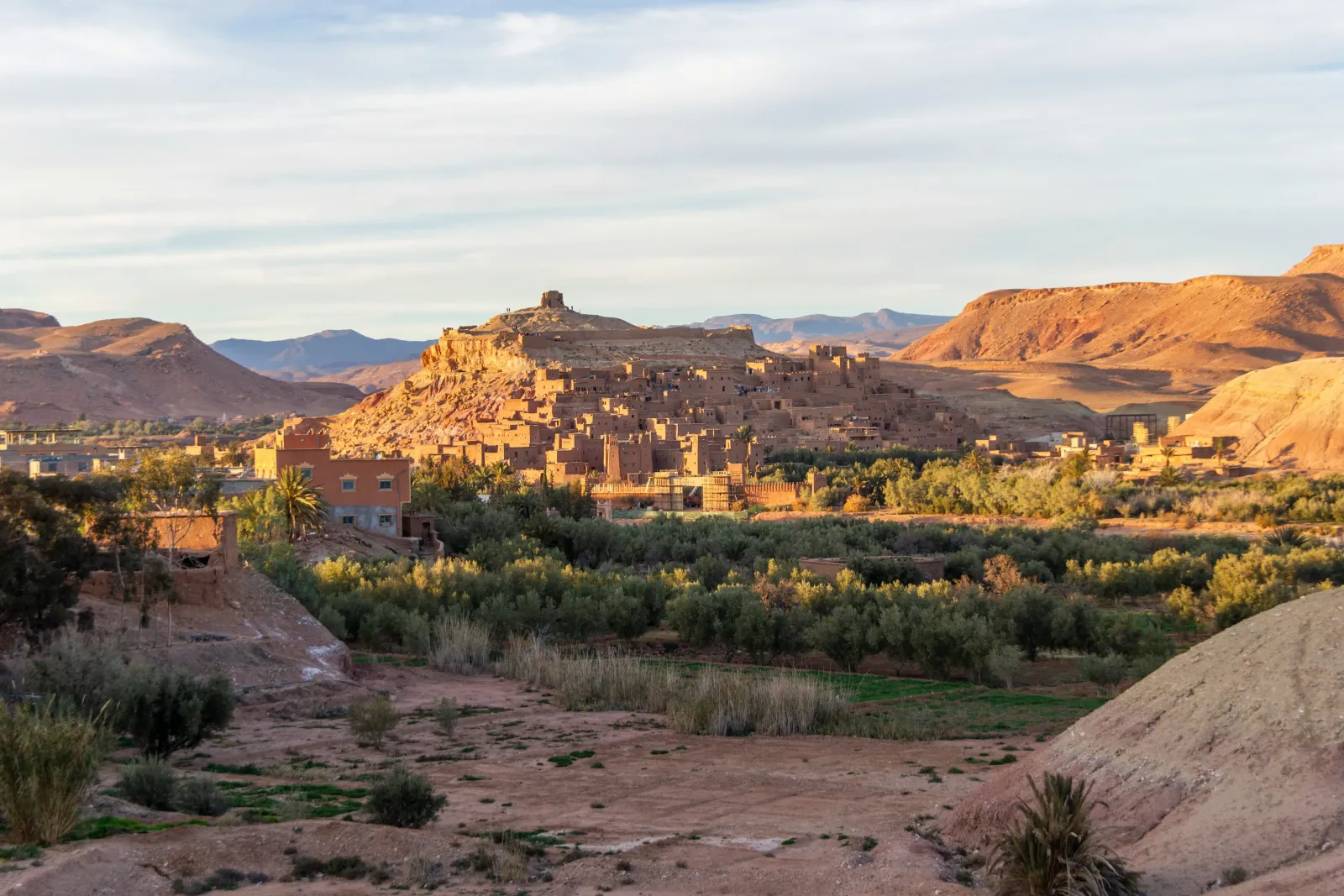
The Dades Valley is usually visited on a longer day trip or as part of a multi-day route toward the Sahara Desert. The “Road of a Thousand Kasbahs” stretches through red rock cliffs contrasted by green valley fields, with classic viewpoints like the hairpin bends near Tizi n’Ouada. Morocco Classic Tours can structure this as a private excursion or as a leg of a desert tour reaching Merzouga.
Kelaat M’gouna and the surrounding Valley of the Roses lie about 2 hours east. In April and May, Damask roses bloom across the hillsides, harvested for rose water and essential oils. The annual Rose Festival draws crowds, but the valley rewards visits any time with its small villages and aromatic distilleries. Often combined with Dades on tailored itineraries.
Morocco Classic Tours can bundle these day trips into custom multi-day programs starting from Fez, Marrakech, or Casablanca, with Ouarzazate as a comfortable mid-journey stop.
The Marrakech–Ouarzazate route is one of Morocco’s classic scenic drives, crossing the High Atlas via the Tizi n’Tichka Pass (around 2,260 m elevation). The journey typically takes 4–5 hours, depending on roadworks, weather, and stops.
Morocco Classic Tours arranges air-conditioned private cars or minibuses with English-speaking drivers. This option allows:
Photo stops at viewpoints above the Atlas Mountains
Visits to argan oil cooperatives or saffron sellers
Detours to Telouet Kasbah via the Ounila Valley
A stop at Aït Ben Haddou en route
Private transfers are the most comfortable and flexible choice, ideal for families, small groups, or travelers prone to motion sickness who benefit from controlled stops.
CTM and Supratours run several services daily between Marrakech and Ouarzazate. Journey time is usually 4.5–5.5 hours, including one rest stop at a roadside restaurant. Ticket prices often run 95–130 MAD one way. Buses are air-conditioned with numbered seats, but they follow the main road without time for sightseeing.
Renting a car in Marrakech gives freedom to stop at mountain passes, small Berber villages, and scenic overlooks. The road is paved and generally good, but includes:
Many bends and sections with steep drops
Occasional snow or fog in winter
Ongoing improvement works that may cause delays
Drivers should be confident on mountain roads. Night driving isn’t recommended.
Domestic flights occasionally operate between Marrakech and Ouarzazate but are less frequent and seasonal. Most visitors prefer overland travel for the dramatic High Atlas scenery—just a few hours in a car reveals some of Morocco’s most spectacular mountain landscapes.
Morocco Classic Tours can integrate the transfer into a larger itinerary—such as a 3–4 day Marrakech–Ouarzazate–Merzouga desert loop—so travelers don’t spend a day merely in transit.
Travelers usually choose between staying in Ouarzazate city or near Aït Ben Haddou, 30–35 km away. Both options work depending on your itinerary and priorities.
You need bus connections, airport proximity, or easy access to restaurants, banks, and currency exchange
You’re using the city as a hub for multiple day trips (studios, Fint Oasis, Dades Valley)
You prefer a wider range of dining options and evening strolls along Avenue Mohammed
Hotels and riads in Ouarzazate range from budget guesthouses near the bus station to mid-range properties with an outdoor pool to film-themed boutique stays with kasbah-style architecture.
You want a more atmospheric, village feel with sunrise and sunset over the ksar
You prefer quieter nights with views of palm groves and mudbrick houses
Your main goal is scenery and slow-paced exploration rather than logistics
Some kasbah-style guesthouses sit on the opposite bank of the river, offering terrace views directly onto the UNESCO site—the perfect place for photography at golden hour.
Below is a clear comparison of accommodation categories in Ouarzazate and Aït Ben Haddou:
Category | Description | Typical Price Range |
|---|---|---|
Budget | Simple guesthouses and riads, clean rooms, basic amenities, good for bus travelers | Low double-digit €/£ per night |
Mid-range | Hotels with pools, a restaurant, and more spacious rooms | Mid double-digit €/£ per night |
Boutique/Luxury | Kasbah-style properties, film-inspired decor, full amenities | Low triple-digit €/£ per night |
Morocco Classic Tours can recommend and book properties matching each traveler’s style and route—whether that means a family room near the studios, a romantic kasbah overlooking Aït Ben Haddou, or a comfortable hotel before heading to a desert camp.
The best months to visit Ouarzazate are March through May and September through November, when daytime temperatures feel wonderfully pleasant and nights stay comfortable for sleeping.
Daytime highs typically reach 20–28°C (68–82°F), with cooler evenings perfect for rooftop dinners. Valleys like the Valley of the Roses bloom in late April and May. This is a popular time for Sahara tours starting or stopping in Ouarzazate.
Similar comfortable temperatures return after summer’s intensity. Clear skies and warm golden light make autumn ideal for photography around kasbahs and rocky desert landscapes.
Very hot—regularly 35–40°C (95–104°F) or higher in July and August. Reduce midday activities and focus on early morning or late afternoon sightseeing. Hotels with an outdoor pool become highly desirable. Spend the hottest hours in shaded courtyards or air-conditioned spaces.
Days are often dry and sunny with highs of 15–20°C (59–68°F), comfortable for walking. Nights can drop close to freezing, especially in December and January—pack warm layers. Snow on the High Atlas passes between Marrakech and Ouarzazate occasionally slows travel but creates spectacular scenery.
Morocco Classic Tours adjusts departure times, routes, and desert camp arrangements to match the season—earlier camel treks in summer heat, warmer bedding, and fires in winter camps.
Ouarzazate sits between the High Atlas and Anti-Atlas ranges, making it a practical jumping-off point for day hikes in oases and valleys as well as multi-day treks deeper into the mountains.
Easy routes suitable for families or those new to desert walking include:
Fint Oasis circuits – Following the riverbed and palm gardens
Tamesla “stork fortress” kasbah – Short walks along the oued (dry riverbed)
El Mansour Eddahbi Lake – Flat terrain with reservoir views
These require no technical skill and offer a taste of the surrounding area without serious exertion.
Morocco Classic Tours can arrange guided day hikes in nearby valleys or longer treks connecting Ouarzazate with High Atlas villages. For travelers continuing to Marrakech, transfers to better-known trekking areas around Imlil and Mount Toubkal can follow an overnight in Ouarzazate.
Contact Morocco Classic Tours in advance via their website or email, sharing:
Travel dates and group size
Fitness level and hiking experience
Interests (scenery, Berber villages, history, photography)
The team can arrange an English-speaking mountain guide and tailored route, plus transport from your hotel to trailheads and back, packed picnic lunches, and any necessary gear.
Sturdy walking shoes or light hiking boots with a good grip
Sun protection: hat, UV sunglasses, high-SPF sunscreen
Layered clothing for temperature swings (cool mornings, hot midday, chilly evenings)
At least 1.5–2 liters of water per person
Hikes around Ouarzazate feature drier, more desert-mountain landscapes compared with the lusher High Atlas routes near Imlil and Mount Toubkal. Morocco Classic Tours can include both environments in longer Morocco itineraries.
Ouarzazate is generally considered safe for tourists. It’s quieter and more relaxed than larger Moroccan cities, with lower levels of hassle in markets and public spaces.
Normal urban precautions apply:
Keep valuables secure and out of sight
Avoid walking in very dark, quiet areas late at night
Agree on taxi fares in advance if the driver doesn’t use a meter
Solo travelers and families routinely visit without issues. The city benefits from a visible police presence and its history as a military center.
Yes—especially if you enjoy film locations, desert landscapes, and historical kasbahs, or if you’re traveling between Marrakech and the Moroccan Desert. Spend at least one night (preferably two) to see the main sites and the surrounding area. Most people find it more rewarding than a rushed lunch stop on the way to Merzouga.
Banks and official exchange offices line the main avenues (Avenue Mohammed V and Avenue Mohammed VI). Some hotels change small amounts at slightly less favorable rates. Use official counters or ATMs rather than informal street changers.
ATMs are available in the city but may be limited in surrounding oases and villages. Withdraw sufficient cash before heading to Fint Oasis, Aït Ben Haddou, or an independent desert trip.
Most local shops and markets operate on a cash basis in Moroccan dirhams. Larger hotels and established local agencies accept cards, though network interruptions occasionally occur.
Wear light but modest clothing, especially when visiting small villages and religious sites.
Ask before photographing local people, particularly women and children
Tipping small amounts (5–10 MAD for cafe service, 10–20 MAD for baggage handling) is appreciated
Morocco Classic Tours provides on-the-ground support for guests in Ouarzazate, including help with logistics, trustworthy local guides, and last-minute changes due to weather or road conditions.
Morocco Classic Tours is a Fez-based, Moroccan-owned tour operator specializing in private, customizable journeys that often route via Ouarzazate on the way to or from the Sahara Desert.
3–4 day Marrakech–Ouarzazate–Merzouga desert tours with camel rides and overnight camps
Fez–Merzouga–Ouarzazate–Marrakech grand loops (4–6 days)
Shorter 2–3 day circuits focused on kasbahs, film sets, and the Atlas Mountains
Door-to-door private transfers
Carefully selected riads and desert camps
English-speaking drivers and guides
Flexible pacing (extra time at Aït Ben Haddou, spontaneous stops in the Drâa Valley)
Possibility to add cooking classes or souk visits in Marrakech or Fez
Visit the Morocco Classic Tours website, browse suggested itineraries, and send details about your group size, dates, and interests. The team responds with a tailored proposal that can be adjusted for families, couples, or small groups.
Encourage yourself to spend at least one night in the city or nearby Aït Ben Haddou. Visit a film studio, explore Taourirt Kasbah, and consider adding a short hike or quad ride. Morocco Classic Tours can schedule these within a wider Morocco itinerary, transforming what could be a simple transit point into a memorable experience.
One full day (1 night) is enough to see Taourirt Kasbah, a film studio, and walk around the center. However, 2 nights is ideal if you also want to visit Ait Ben Haddou at sunrise or sunset, explore Fint Oasis, or take a short quad or hiking tour. Travelers incorporating Ouarzazate into a longer desert tour often spend one night before continuing to Merzouga or M’Hamid.
Ouarzazate offers more services—restaurants, banks, a bus station, and airport access—and works best as a touring base for multiple-day trips. Aït Ben Haddou feels more atmospheric and traditional but is quieter with fewer amenities. Choose Ouarzazate for flexibility and multi-day exploring; choose Aït Ben Haddou if your main goal is scenery, photography, and a slower pace.
A wide range of classic and recent productions: Lawrence of Arabia, The Man Who Would Be King, The Jewel of the Nile, The Mummy, Gladiator, Kingdom of Heaven, Babel, Martin Scorsese’s Kundun (with its reconstructed Tibetan temple), Game of Thrones, Prison Break, and scenes from Outer Banks. Many sets remain at Atlas Studios and CLA Studios for visitors to explore.
Ouarzazate is a common staging point for Sahara trips, but it isn’t located in the dunes themselves. Merzouga (Erg Chebbi) is roughly 6–7 hours by road via Tinghir. M’Hamid and Erg Chigaga lie about 5–6 hours south. A minimum 2–3 day round trip is recommended for any desert experience, including camel treks and overnight camps. Morocco Classic Tours arranges these with standard or luxury desert camps.
Yes. Ouarzazate has a history of Berber, Jewish, and Arab communities living side by side. The Old Synagogue (now a small museum) displays religious artifacts and tells stories of coexistence before most of Morocco’s Jewish population emigrated in the mid-20th century. Interested travelers can ask a local guide or Morocco Classic Tours to include this stop in a half-day city tour.
Compare Morocco group tour agencies by trip style, reviews, pace, transport and inclusions. Learn wh...
Read this article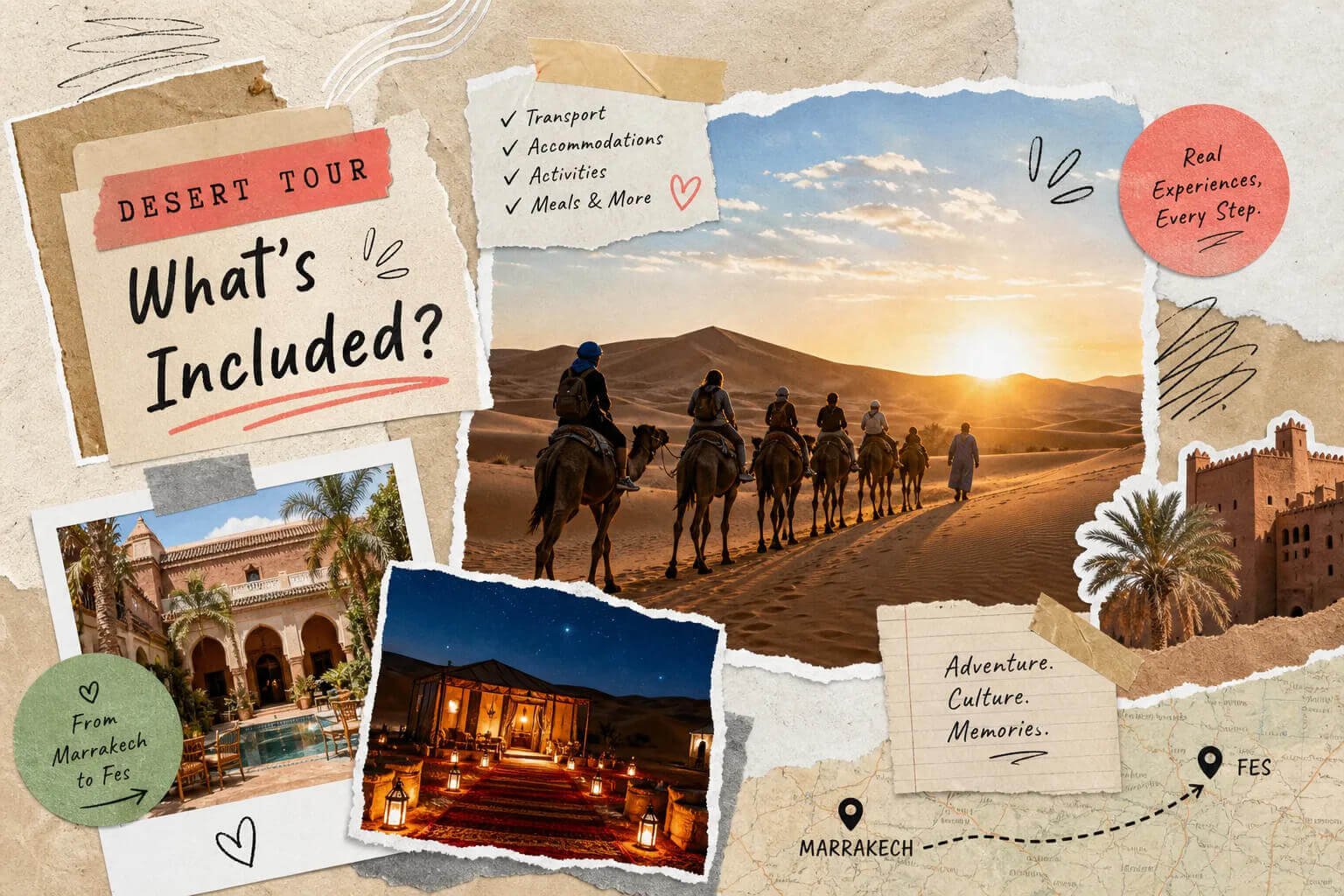
Uncover what a Marrakech to Fes desert tour offers, including camel rides, desert camps, and rich cu...
Read this article
Join our Merzouga Overnight Tour for an authentic desert experience. Enjoy camel rides, comfortable ...
Read this articleWant cool tour deals and tips about Morocco? Enter your email and we’ll send them to you each month!
